

How 2D and 3D art And Animation Outsourcing Estimation Works
2D and 3D art and animation outsourcing estimation works as a structured process in which a studio analyzes your brief, prices every task on a work breakdown structure, and returns a line item total you can compare and trust. The estimate is not a guess. It is a spreadsheet of tasks, hours, and rates built from one thing only, how complete your brief is. A clear brief produces a fast, accurate quote. A vague one produces a padded price.
Here is the short answer in three lines. A studio estimates in five steps: analyze your requirements, list what is missing, send you questions, build the work breakdown structure with hours and rates, and confirm the scope with you. The accuracy of the number depends entirely on how completely you answer their questions. We have run this process daily since 1997 by delivering 2D and 3D art, character, and animation outsourcing for global clients.
How the Estimation Process Works
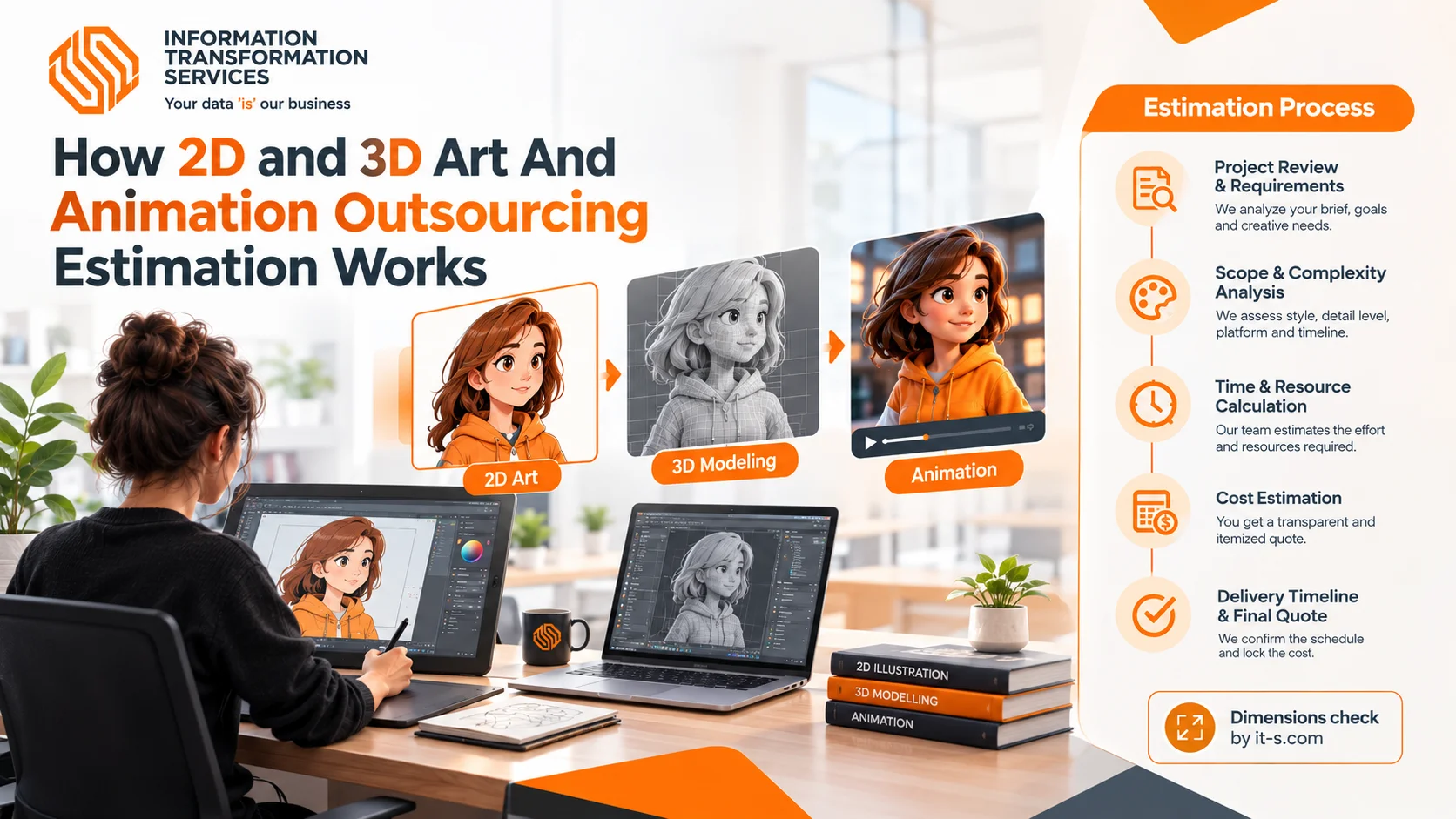
Every serious studio follows the same five stage logic. Learn the stages and you will be ready for the part that matters most, answering their questions quickly and completely.
Requirement analysis: The studio reads your brief and compares it to past projects with similar requirements to size the effort. Anything unfamiliar gets flagged before any number is committed.
Preliminary documentation: The team drafts a rough work breakdown structure and a list of information you did not provide.
Question resolution: This stage decides your quote. The studio asks about technical specs, deliverable formats, quality level, budget, and deadline. How completely you answer directly controls how accurate the estimate is.
Estimation: With full information, the studio builds the detailed work breakdown structure, a spreadsheet of every task, its hours, its rate, and the running total. This is the document you should always ask to see.
Confirmation: You review the draft, request changes, and agree on final scope before production starts. The plan becomes real only when both sides agree.
The rule that governs all of this is simple. The estimate is only as accurate as your answers. Studios resolve gaps in your brief their own way. One studio asks questions first, which is slower and tighter. Another quote against its own assumptions, which is faster and broader. Neither is better by itself. What matters is that the studio writes its assumptions down, because that gives you something to check against your intent.
2D and 3D Art and Animation Cost Ranges
Pricing in 2026 uses three different units, and each unit answers a different project type. Per-minute pricing covers finished animation. Per asset pricing covers game art and models. Hourly pricing covers concept exploration and evolving work. Know your unit before you read a quote.
Animation Cost per Minute
2D whiteboard animation runs $50 to $1,000 per minute, 2D motion graphics run $200 to $3,000 per minute, and 2D character animation runs $300 to $5,000 per minute. 3D product animation runs $500 to $8,000 per minute, while 3D character animation, the most labour heavy category, runs $1,000 to $12,000 per minute and beyond at premium film grade quality. One constant runs through every 3D quote: 3D animation typically costs three to eight times more than comparable 2D work, because modeling, rigging, lighting, and rendering add whole production stages that 2D never touches.
Game Art Price per Asset
2D assets are the cheaper entry point. A simple 2D character with concept art runs $300 to $800, a detailed mid-core character runs $800 to $2,500, and a single screen 2D environment runs $500 to $2,000. 3D assets step up sharply. A simple low poly prop runs $100 to $800, a detailed prop with PBR textures runs $300 to $800, a rigged mobile character runs $1,500 to $4,000, and a PC and console quality character runs $4,000 to $12,000. Animated creature models run $3,000 to $12,000, and a modular environment set runs $3,000 to $10,000. Animation clips are priced separately, from $150 to $600 for a 2D Spine clip to $400 to $1,500 for a 3D rigged clip.
Hourly Rates by Region
Geography explains why two studios quote differently for the same brief. Eastern European studios run $50 to $100 per hour, studios in India, Vietnam, and the Philippines run $40 to $80 per hour, and Western European, UK, and North American studios run $100 to $200 per hour. Lower cost regions need a more detailed brief and stronger quality control, because the rework hidden in a bargain can erase the savings.
Realistic Timelines for an Outsourced Project
Timelines are part of an estimate, and knowing realistic turnaround helps you avoid rushed quotes and surprise surcharges.
2D production is fast: A well briefed 2D character goes from sketch to final in three to seven days. A fully styled environment set takes one to two weeks. Revisions on 2D are relatively cheap and quick.
3D production is slower: A stylized 3D character without a complex rig takes one to two weeks. A mid-complexity character from concept to a rigged, engine-ready asset takes two to four weeks. A photorealistic hero character with a full body rig, hair, and facial setup takes three to six weeks or more.
Batch and team timing: A validation batch of two or three representative assets, used to align style and technical standards, takes one to two weeks. Once the recipe is locked, a steady state pod of three to four artists delivers fifteen to twenty five production ready props per month, or three to five characters, depending on complexity.
Animation timelines scale with runtime: A one-minute 2D motion graphic takes two to four weeks, including script and sound. A short 3D animation with modeling, rigging, and rendering runs longer, and heavy scenes extend every milestone. When a studio gives you a timeline, ask what it includes, because a calendar date without a defined deliverable means little.
What Affects the Cost of the Project
These are the levers that actually change a quote, ranked by impact.
Art style and quality tier: Template content costs a fraction of custom broadcast grade work. Stylized low poly art is cheaper than photoreal, which demands far more texture and lighting hours.
2D versus 3D. The pipeline difference alone multiplies cost three to eight times.
Rigging, animation, and engine integration: A static asset is cheaper than an animated one. Facial rigging, physics, and multiple animation sets change a character into a different scope entirely. Delivering an engine ready asset for Unity or Unreal Engine, with collision and level of detail, also costs more than a static export, and the gap is one of the most expensive things to discover late.
Add-ons and deliverables: Scriptwriting, voiceover, licensed sound, source files, extra languages, and vertical format together raise a base cost by 40 to 80 percent. Source files alone often carry a 20 percent surcharge.
Revision rounds: Some studios include feedback cycles in the base price. Others bill revisions separately. A lower headline price with revisions billed apart can cost more than a higher quote that already includes everything.
Timeline: Rush production adds 30 to 60 percent on top of base rate. On a $5,000 project, that is $1,500 to $3,000 of avoidable cost. Volume also cuts the other way, with many studios granting bulk discounts on batches and long runtime videos.
Fixed Price, Payment per Hour, or Retainer
The pricing model decides who carries the risk of a wrong estimate. Match it to how settled your scope is.
Fixed price suits well specified, stable batches with a clear asset list. The studio carries estimation risk, so the number may include contingency.
Per asset pricing suits standardized assets both sides can picture before production. The trap is that a hero character and a simple prop are called the same word yet carry totally different review loads.
Time and materials suits concept exploration and shifting requirements. The number can be lower, but a vague brief can run over and you carry more budget tracking.
Milestone pricing suits production with real approval gates. Each approval closes a piece of scope, and added work triggers a change order.
Retainer or dedicated team suits ongoing production where the roadmap moves. Capacity stays reserved and the team keeps context across weeks and months.
Producers who outsource daily use one test. Choose the model that creates the fewest surprise conversations after week two.
Example: How an Estimate Adds Up
Two examples show how a real estimate is assembled, so you recognize every line in your own quote.
A rigged 3D character for a PC game Base per asset price for a stylized rigged character with two animations runs near $4,500. Source files add 20 percent, roughly $900. Two paid revision rounds add $600. With standard timing the estimate lands near $6,000. Add a rush schedule and a 30 percent surcharge lifts it toward $7,300. The same asset with no source files, one revision round, and no rush can come in near $5,000. Small choices compound fast.
A one minute 3D product animation for an e-commerce launch. Premium 3D product animation runs near $2,500 per minute. Scriptwriting, voiceover, and licensed music add about $1,500. Source files carry a 20 percent surcharge near $500. A rush timeline adds 30 percent of the base, another $750. The stack lands near $5,250 for a single minute, before effects or extra languages. Most buyers are surprised that the base rate is only half of a realistic animation budget.
2D or 3D: Which Should You Outsource First
Outsource what needs the most specialist skill or volume, and keep in house what needs brand alignment and rapid iteration. Start with 2D if you are mobile first, small, or have not locked your art style, because it is cheaper per asset, faster to revise, and a lower risk first engagement. Start with 3D if your visual identity is 3D first and you have a solid art direction document. A split model also works well, 3D characters and environments are for the partner, and UI and 2D marketing assets are kept in-house. The contrast is stark on cost: 2D assets run $300 to $2,500 each, 3D assets run $1,500 to $12,000, and production time runs days for 2D versus weeks for 3D.
When Outsourcing Is Cheaper Than an In House Team
The question underneath most estimation queries is whether the work should be sent out at all. The honest answer depends on your numbers.
An in-house team is justified when you have a stable workload for years ahead and a style so specific that training someone new costs more than maintaining staff. But the costs that ambush internal growth are rarely the salaries. They are the ramp. New hires typically need their first one to three months to reach full output, hardware and licenses run roughly $5,000 to $10,000 per added artist, and idle capacity keeps seniors paid between projects. A fully loaded in-house AAA-tier art pod of a senior modeler, a technical artist, and a rigger commonly runs in the tens of thousands of dollars per month, before recruiting time and idle risk.
Outsourcing turns fixed costs into variable costs. You pay for production rather than recruitment, onboarding, benefits, and idle time. Capacity scales to the roadmap and releases when the roadmap dips. For short-term or specialist work it is almost always cheaper because you only pay for the hours actually consumed. The economics of transparency frame the final decision: a slightly higher rate from a studio with clean communication and a defined pipeline almost always delivers a lower total cost than a bargain that needs expensive rework.
Budget by Project Size
Realistic anchors make an estimate readable. These 2026 budget bands give you a planning base.
For a casual mobile game, a full character set of six to ten characters runs roughly $2,000 to $5,000, and a UI kit plus a few background environments fits the same band. A complete visual package for a mid-core mobile or indie title, including characters, UI, backgrounds, and basic animation, runs $5,000 to $15,000. Full 2D art production for an indie PC title with a significant number of assets runs $15,000 to $40,000. A full environment package for a small indie game, five to seven environment sets, lands between $15,000 and $40,000 depending on complexity.
Two budget rules do the heavy lifting. First, outsourced art commonly takes 10 to 20 percent of your total production budget, rising toward 30 percent or more for art-intensive genres. Second, add a 20 to 30 percent buffer on top of raw asset costs to cover revision rounds, integration support, and project management overhead, which typically runs 10 to 15 percent of the art budget on its own. Projects that skip the buffer routinely run over, not because the studio misquoted, but because hidden costs were never planned.
What to Send with Your Estimate Request
Hand the studio everything on this list up front, and the quote tightens immediately.
Visual references: Reference images for final quality and style are non negotiable, because they turn guesswork into a concrete target.
Use case and technical specs: State whether the work is for real time use or rendered output, note polygon budgets, texture resolutions, and the engine or renderer, and name deliverable formats.
Budget and timeline. Studios price very differently once they know your range. Sharing it does not raise the number, it makes the number honest.
Pricing model and ownership: State whether you want fixed price, time and materials, or a dedicated team, how many revision rounds are included, and whether you need editable source files and full ownership. IP transfer and layered source file delivery are not the same thing, so name both in writing.
How to Compare Quotes and Spot Red Flags
Estimates are comparable only when the scope behind them is the same. Before comparing totals, line up the work breakdown structure detail, what is included, the billing model, revision limits, acceptance criteria, source file and ownership terms, and quality references. A studio that shares a detailed breakdown is showing you what you pay for. A single round number with no breakdown is hiding something.
The red flags are consistent. An instant quote with zero questions means the project was not analyzed. A number far below every other quote means the scope was not read. A refusal to explain the breakdown, or pressure to sign before seeing the work, is a warning sign. And studies of outsourced art repeatedly show that a cheap studio with vague processes adds 40 to 60 percent to effective cost through revision cycles and rework, so the cheaper headline is rarely the cheaper total.
Key Terms You Will See in an Estimate
This is the vocabulary a studio uses to price your project, and knowing it lets you read any estimate correctly.
Work breakdown structure (WBS). The spreadsheet at splits a project into every task with hours and rate, making the total transparent item by item.
PBR: Physically based rendering is the standard for realistic materials using properties like roughness, metalness, and base color.
Level of detail (LOD): Multiple versions of a model at different polygon counts, used by game engines like Unity and Unreal Engine to balance quality and performance
Rigging and skinning: Building the skeleton of a character and attaching the mesh to it so it can animate.
Retopology: Rebuilding geometry with clean polygon flow so a model animates and imports correctly.
Statement of work (SOW) and master services agreement (MSA). The documents that define deliverables, milestones, revision terms, and legal terms of an engagement.
NDA and IP: A non-disclosure agreement protects your build, and intellectual property terms decide who owns the finished work and source files.
What This Means for You
Estimation follows a repeatable process, but the number you get depends on your inputs. Provide references, technical specs, budget, and ownership terms, and every studio on your shortlist can price your project tightly. Know the three pricing units, the drivers that move a quote, and the model that matches your scope. Compare quotes on scope and deliverables, never on the headline alone. And remember that timelines and budgets have real industry anchors, so a quote and a delivery date can be judged against market reality rather than accepted on faith.
The strongest position a buyer can be in is to walk into a studio with a prepared brief and a fair comparison framework. That is exactly the position this guide is meant to give you. If you would rather hand the whole project to a team that prices and delivers this work daily, Information Transformation Service has done exactly that since 1997, and we respond to every brief with a clear estimate, typically within 24 business hours.