


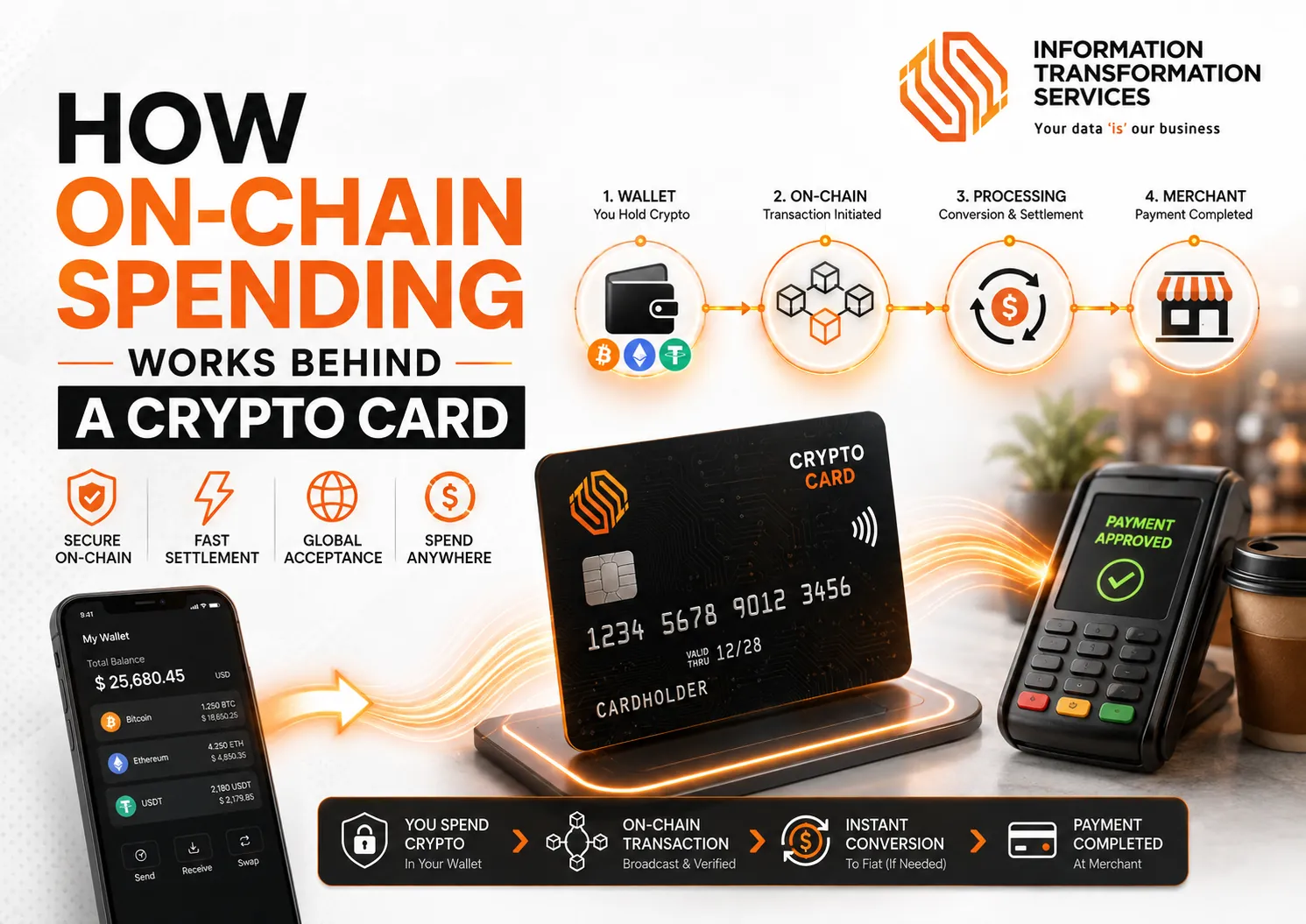
How On-Chain Spending Works Behind a Crypto Card
Tapping a crypto card feels instant and ordinary, but a quiet piece of engineering runs in that half-second: a handshake between blockchain settlement and decades-old card rails. Understanding it is the fastest way to tell a well-built card from a fragile one, and resources such as nomadcrypto.cards compare products on those fundamentals rather than on marketing.
At the base sits the asset: Bitcoin, Ether, or increasingly a stablecoin. Stablecoins have become the backbone of spending because they remove volatility from the equation. The provider accesses these funds either through a custodial account or, in newer designs, a non-custodial smart-contract wallet that releases value only at the moment of authorization.
The middle layer is conversion and authorization. When you pay, the provider receives an authorization request from the card network denominated in fiat. It then draws from a pre-funded fiat float or executes a real-time crypto-to-fiat conversion, locks the rate, and approves the transaction, all inside the network’s strict timeout, which is often measured in a couple of seconds. This is where cheap cards stumble and well-engineered ones stay reliable, because a conversion that misses the window becomes a declined payment at the till.
The top layer is the card network and the issuing institution. Visa and Mastercard never touch crypto; they see a compliant fiat transaction from a licensed issuer. That is why a crypto card is really a crypto-funded fiat card, and why the quality of the banking partner matters as much as the on-chain wiring. The same partner also handles chargebacks and dispute resolution when something goes wrong.
The most interesting frontier is non-custodial spending using account abstraction, where a smart wallet authorizes a card payment without the provider ever holding your keys. It brings hard problems around latency and failed authorizations, but it points to where the category is heading.
There is also a security dimension the marketing skips. Custodial models concentrate funds in provider hot wallets, historically a prime target. Non-custodial models push that risk back to the user but demand solid key management. Neither is a free lunch, and the right pick depends on how much operational responsibility you want to hold.
For a buyer, the takeaway is that architecture, meaning stablecoin support, conversion reliability, custody model, and network coverage, predicts real-world experience better than any reward headline. Comparing cards on those axes is tedious by hand, which is exactly why spec-level comparison has become the sensible way to choose.