

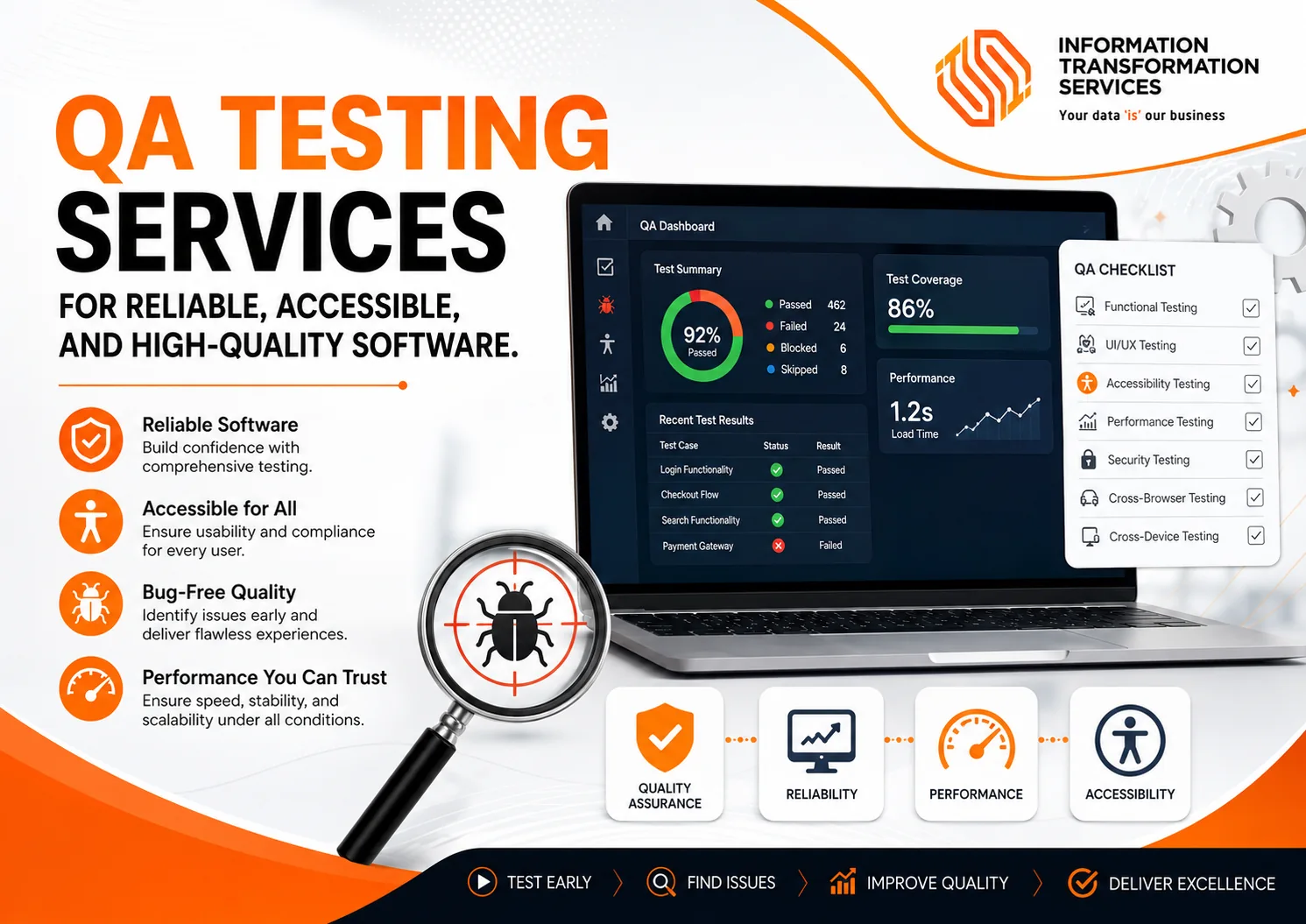
QA Testing Services for Reliable, Accessible, and High-Quality Software
Modern software must do more than work under ideal conditions. It must remain stable across devices, browsers, integrations, user journeys, traffic levels, and frequent updates. Professional qa testing services help organizations detect defects early, protect customer trust, and release products with greater confidence. QualityLogic is one example of an experienced testing partner, providing functional, mobile, web, and streaming media testing alongside TestNitro test automation, API testing, digital accessibility and ADA-focused compliance support, and smart grid and energy testing. Its on-demand, onshore, and hybrid solutions can also help Agile teams improve quality without slowing development.
What Are QA Testing Services?
Quality assurance testing services are structured processes used to evaluate whether software meets technical requirements, business expectations, and user needs. They cover more than finding obvious bugs before launch. A complete QA program examines how a product functions, integrates, performs, scales, and serves people in realistic conditions.
Testing can begin during requirements planning and continue through development, release, and maintenance. Teams may validate workflows, test APIs, examine devices, automate regression checks, evaluate accessibility, or measure performance under load.
The purpose is not to claim that software is perfect. No practical program can test every possible combination. Effective qa testing services identify the areas of greatest risk, establish meaningful coverage, and provide evidence that decision-makers can use before approving a release.
Why Software Quality Matters
A defect is rarely just a technical inconvenience. A broken checkout can reduce sales, a failed API can disrupt a business partnership, and an inaccessible form can prevent someone from completing an essential task. Poor streaming playback may drive cancellations, while repeated mobile crashes can cause users to uninstall an app.
Production defects also interrupt development because engineers must investigate, repair, and retest problems instead of building new features. A consistent QA process shows product owners what has been tested, which defects remain open, and whether critical journeys are stable.
Functional Testing Validates User Workflows
Functional testing checks whether each feature behaves according to its requirements. Testers examine inputs, outputs, permissions, calculations, navigation, validation rules, error handling, and interactions between features. They also test negative scenarios involving invalid data, interrupted transactions, missing information, and expired sessions.
Good functional testing reflects real use. For an e-commerce platform, coverage may include search, checkout, payment, and order confirmation. For a business application, it may include access controls, reporting, file handling, and approvals.
Manual testing remains valuable when observation and judgment are required. Testers can notice confusing behavior, inconsistent messages, and unexpected workflow problems that predefined scripts may miss. Mature qa testing services therefore, combine manual and automated methods rather than treating one as a complete replacement for the other.
Web and Mobile Testing Protect the Experience
Web applications operate across browsers, operating systems, screen sizes, networks, and third-party services. Web testing evaluates functionality, compatibility, responsiveness, navigation, content presentation, forms, and integrations.
Mobile testing adds more variables, including iOS and Android versions, device models, permissions, orientation, battery conditions, and connection types. Cameras, notifications, biometric authentication, location services, and background processes may also require validation.
Emulators support early testing, but real-device testing provides stronger evidence of customer experience. A risk-based device matrix directs time and budget toward the combinations that matter most.
Streaming Media Testing Requires Specialized Coverage
Streaming platforms connect applications, content services, advertising systems, authentication, playback controls, networks, and numerous connected devices. A feature that works in a browser may fail on a smart television, streaming stick, game console, or older operating system.
Testing may cover sign-in, content discovery, playback startup, buffering, captions, audio-video synchronization, ad insertion, subscriptions, parental controls, and resume functionality. It should also examine behavior when bandwidth changes or users switch between devices.
Because these failures are immediately visible, comprehensive qa testing services should evaluate the complete viewing experience rather than isolated components.
Test Automation Accelerates Regression Testing
Frequent releases make manual regression testing difficult to scale. Every change creates a possibility that an existing feature may stop working. Automation helps by running repeatable checks quickly and consistently.
Automation is most useful for stable, high-value workflows verified across many builds. It can support smoke tests, regression suites, browser coverage, and continuous integration pipelines, but still requires script maintenance and failure analysis.
QualityLogic offers TestNitro as a managed web test automation service. The company describes it as a way to build automatable user-interface coverage rapidly, maintain that coverage during each sprint, and connect tests with a client’s CI/CD process. This model can help teams gain automation results without creating and maintaining an entire automation function internally.
Human involvement remains essential. Engineers must design meaningful scenarios, review outcomes, separate actual defects from script problems, and decide which tests should remain manual.
API Testing Finds Problems Below the Interface
APIs connect interfaces, databases, payment platforms, identity systems, analytics tools, mobile apps, and third-party services. When an API fails, the visible application may break even when its interface looks correct.
API testing validates requests, responses, status codes, authorization, data formats, error handling, business rules, and performance. It can also test malformed inputs, missing fields, rate limits, and boundary conditions. Because API tests run below the interface, they often provide faster and more precise feedback than end-to-end checks.
Strong qa testing services include API coverage within the wider strategy, especially for service-based architectures in which one customer action may depend on several connected systems.
Digital Accessibility Expands Access
Accessible software allows people with disabilities to perceive, understand, navigate, and interact with digital content. Accessibility testing may assess keyboard navigation, screen-reader support, heading structure, labels, focus order, color contrast, captions, error messages, and alternative text.
Automated scanners can identify some issues, but they cannot determine whether an entire workflow is usable. Manual evaluation by accessibility professionals, including people familiar with assistive technologies, provides essential context.
Organizations commonly use the Web Content Accessibility Guidelines as a technical reference when supporting ADA-related accessibility objectives. QualityLogic provides digital accessibility and WCAG compliance testing for web, mobile, and software products. Addressing accessibility during design and development is more effective than treating it as a final pre-release inspection.
Accessibility improvements often benefit everyone through clearer labels, predictable navigation, understandable errors, and better-structured content.
Smart Grid and Energy Testing Needs Domain Expertise
Energy technology combines software, devices, communication protocols, utilities, distributed energy resources, and certification requirements. Testing may involve conformance, interoperability, communication behavior, implementation standards, and complex device interactions.
QualityLogic supports smart energy development through test tools, training, consulting, and services related to technologies such as OpenADR and IEEE 2030.5. Specialized knowledge matters because general software experience may not be enough to interpret industry standards or reproduce energy-system scenarios.
Companies developing smart grid, demand-response, vehicle-to-grid, or energy-management products should select qa testing services with relevant protocol and certification experience. Domain expertise can strengthen test design and reveal implementation risks before deployment or formal evaluation.
How QA Supports Agile Teams
Agile teams release small increments frequently, so testing cannot remain a separate phase at the end. QA professionals should contribute during refinement, sprint planning, development, review, and release decisions.
Early involvement helps identify unclear acceptance criteria before coding begins. During a sprint, testers can validate completed work, automate suitable regression scenarios, and deliver fast feedback.
An external partner should integrate with the team’s tools and routines. Testers may join stand-ups, work from the same backlog, document reproducible issues, and coordinate with developers and product owners. The objective is not to make QA a final gate. It is to make quality a shared responsibility supported by independent expertise.
On-Demand, Onshore, and Hybrid Testing
Different organizations need different delivery models. On-demand testing is useful during a release deadline, temporary workload spike, specialized requirement, or urgent quality problem. It adds capacity without permanent hiring.
Onshore testing can simplify communication, scheduling, security coordination, and collaboration. A hybrid model combines onshore leadership with offshore or nearshore resources to balance communication, coverage, and cost. Clear ownership, documentation, review standards, and escalation paths are essential for distributed teams.
QualityLogic offers on-demand support, US-based onshore QA operations, and hybrid options. The right model depends on product complexity, budget, deadlines, security needs, and the amount of daily collaboration required.
How to Choose a QA Testing Partner
Start by defining the business risks testing must address. Consider critical user journeys, supported platforms, release frequency, integrations, accessibility needs, industry requirements, and the consequences of failure.
A provider should translate those risks into a practical strategy. Ask how the team designs coverage, reports defects, measures progress, maintains automation, protects information, and adapts when priorities change. Relevant technology and industry experience should also influence the decision.
Avoid selecting qa testing services only by hourly rate. Weak test design, unstable automation, unclear reports, and slow feedback create hidden costs. The better measure is the value delivered through useful coverage, actionable findings, reduced release risk, and reliable collaboration.
Build Quality Into Every Release
Reliable software comes from deliberate engineering, continuous validation, and attention to real users. Functional, web, mobile, streaming, API, accessibility, automation, and specialized energy testing each address different risks. Together, they provide a stronger view of product readiness.
Professional qa testing services give organizations the skills and capacity to test effectively while developers focus on building the product. With an experienced partner such as QualityLogic, Agile teams can select on-demand, onshore, or hybrid support to match their needs. The result is more than fewer bugs. It is software that performs reliably, serves a wider audience, and earns lasting customer confidence.