

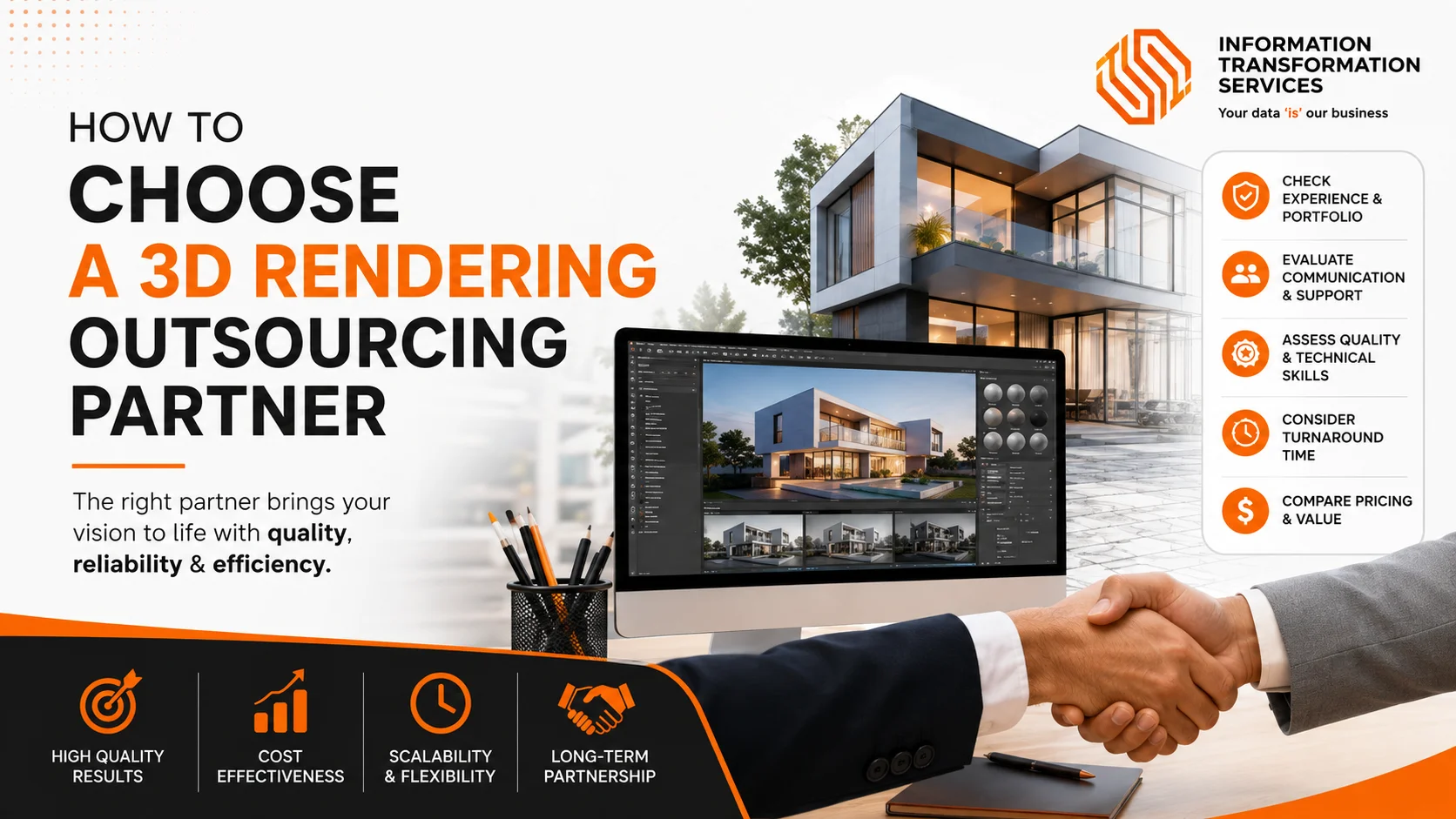
How to Choose a 3D Rendering Outsourcing Partner
A strong portfolio can show what a 3D visualization company is capable of producing, but it does not always show how that company will perform on a real project. Two providers may produce equally impressive images while differing significantly in project experience, communication, revision handling, turnaround reliability, pricing, and production capacity.
Quick answer: Choose a 3D rendering outsourcing partner by comparing seven factors beyond portfolio quality: relevant project experience, rendering quality and consistency, communication and responsiveness, revision handling, turnaround reliability, pricing transparency, and production capacity.
At ITS, we have been producing architectural and product visualizations for clients across real estate, hospitality, and design since 1997. Based on this experience, this guide explains what to evaluate at each stage of the outsourcing process. Most problems become visible only after a project begins, so looking beyond the initial portfolio can help you choose a provider that is reliable throughout the entire project
Why the Right 3D Rendering Outsourcing Partner Matters
Choosing the right partner affects far more than final image quality. A suitable studio delivers more consistent results, cuts down on unnecessary revisions, communicates clearly, meets deadlines reliably, and absorbs growing project volume without adding management overhead to your internal team.The difference becomes especially noticeable once you move beyond a single rendering and start outsourcing multiple projects or recurring work.
Pricing, turnaround times, revision policies, and production workflows vary between providers and projects. Confirm these details directly with the company. Put the important requirements in the project brief, quotation, or agreement before committing to substantial work.
More Consistent Quality Across Projects
A reliable partner reproduces a consistent standard across multiple images, not just one impressive portfolio piece.
That means holding the line on modeling accuracy, materials, lighting, composition, post-production, and final output. This matters most when you’re outsourcing renders for multiple properties, products, or marketing campaigns at once.Over time, a good studio also learns your visual standards, so you stop having to re-explain the same requirements on every job.
Fewer Unnecessary Revisions
Revision cycles are often where the quality of an outsourcing relationship becomes obvious.
With a poor-fit provider, you may find yourself repeatedly correcting camera angles, materials, proportions, or missing details because the brief wasn’t understood properly in the first place. A stronger studio reviews drawings, references, specifications, and visual requirements before production starts, and raises questions when something is unclear.
Revisions will still happen, but they become targeted improvements rather than repeated fixes for preventable mistakes.
More Predictable Delivery
Rendering deadlines depend on more than production speed. Workload, project complexity, feedback turnaround, revision capacity, and artist availability can all affect delivery.
A dependable outsourcing partner gives realistic timelines and flags early if something might affect the schedule. That makes it far easier to coordinate client presentations, property launches, design approvals, or marketing campaigns without constantly chasing the rendering team for status.
Better Communication and Less Management
Good communication prevents small misunderstandings from turning into expensive revisions. An experienced studio knows when to ask about unclear drawings, materials, camera positions, landscaping, furniture, or other project details, and provides clear updates so your team always knows what’s done and what needs attention.
This reduces the management burden on your architects, designers, marketers, or project managers, who can then focus on their primary responsibilities instead of micromanaging every image.
Easier Scaling When Workload Increases
Rendering demand can change quickly. You might need a handful of images for one project and several dozen for another.
The right partner should have enough production capacity to absorb that increase without sacrificing quality or stretching deadlines. This matters most for architecture firms, real estate companies, agencies, and any business with recurring visualization needs.
Better Long-Term Collaboration
The value of a good outsourcing partner tends to compound over time.
Once a team understands your preferred visual style, file structure, briefing process, camera preferences, approval workflow, and quality standards, future projects need far less explanation.
For example, on a recurring architectural visualization project, a dependable partner might flag unclear façade materials or camera requirements before production even begins. That early catch can prevent several rounds of corrections later.
This is the real payoff of choosing well: you’re not just outsourcing image production, you’re building a workflow where quality, communication, revisions, capacity, and delivery all get more predictable with each project.
What Should You Look for in a 3D Rendering Outsourcing Partner?
The most important things to check are relevant project experience, consistent quality, a reliable workflow, clear communication, realistic turnaround times, and a well-defined revision process. Pricing, team capacity, reputation, and a test project can then help confirm whether a provider actually fits your workload.
I wouldn’t give every factor equal weight, though. A strong portfolio matters, but it counts for much less if the company has little experience with your type of project, can’t hold quality across multiple images, or becomes hard to manage once revisions begin.
How to Evaluate a 3D Rendering Company’s Portfolio
A strong portfolio should show more than attractive images. When evaluating a company, look for work similar to your project in type and complexity. Then assess lighting, materials, reflections, perspective, proportions, realism, detail, and consistency across multiple projects. One polished hero image isn’t evidence that a team can hold that same standard through an entire real project you can browse how we approach that range across different project types in our own 3D rendering portfolio.
From a professional standpoint, I’d evaluate a portfolio in the following order.
1. Start With Projects Similar to Yours
If you need exterior renders for a large residential development, a portfolio dominated by small apartment interiors tells you little about the team’s ability to handle façades, landscaping, roads, vegetation, multiple buildings, and large-scale context.
Look for similarities in project type, scale, design style, level of detail, number of images, technical complexity, and intended use. The closer the examples are to your requirements, the stronger the portfolio is as evidence of capability.
2. Compare Similar Levels of Complexity
Two renders can look equally polished while requiring very different levels of production skill.
A simple bedroom is a different challenge from a hospitality interior with custom furniture, reflective surfaces, decorative lighting, artwork, people, and complex materials.
When reviewing a studio’s work, compare examples with a similar level of complexity to your own project. If your work involves extensive landscaping, curved architecture, custom products, complicated lighting, transparent materials, or many visible elements, look for proof the team has handled those challenges before.
This is where non-expert buyers often get misled focusing on visual attractiveness while overlooking how hard the image actually was to produce.
3. Inspect Lighting, Materials, and Reflections

Lighting, materials, and reflections reveal a lot about the quality of a render.Check whether shadows and highlights support a believable light source. Look at whether shaded areas keep natural detail. In interiors, notice how daylight interacts with artificial lighting rather than every surface appearing equally bright.
Materials should respond naturally to light too. Wood, stone, fabric, metal, glass, concrete, and painted surfaces shouldn’t all carry the same shine or texture.
Most professional studios render with engines such as V-Ray, Corona Renderer, or Lumion. The specific engine matters less than whether the final output behaves like a real photograph; reflections that are completely absent, excessively strong, or physically inconsistent make an otherwise attractive image feel synthetic.
You don’t need to understand the rendering software to judge this. Just ask whether the surfaces behave the way you’d expect in a real photograph. For a more technical look at how this is actually set up before rendering, our walkthrough on setting up a 3ds Max scene for architectural visualization covers the lighting and material decisions that shape the final image.
4. Check Perspective and Proportions
Even an accurate 3D model can look wrong if the camera is poorly positioned. Look at vertical lines, room proportions, edge distortion, and the relationship between familiar objects. An excessively wide field of view can make rooms appear unusually large and stretch furniture near the edges.
For exterior work, consider whether the camera height and viewpoint make sense for the intended use.
Also use familiar objects people, doors, chairs, cars, stairs, kitchen appliances to judge scale. Subtle proportion errors may not immediately look wrong, but they make an image feel unnatural.
5. Look Beyond the First Impression
Photorealism comes from many small decisions working together. Look closely at furniture edges, window frames, door hardware, curtain folds, seams, grout lines, vegetation, fixtures, and the points where different materials meet.
Watch for repeated textures, overly sharp edges, unnatural object placement, duplicated-looking vegetation, and objects that appear to float rather than sit naturally on a surface.
These details matter because a render can look excellent at thumbnail size while losing credibility the moment you look closer.
Does the 3D Rendering Company Have Experience With Your Type of Project?
A company can have an impressive portfolio and still be a poor fit for your project if it has limited experience with your type of work. Project-specific experience matters because different rendering assignments require different workflows, technical inputs, levels of accuracy, and production challenges.
Look beyond whether the images look good. Check whether the team has previously handled projects similar to yours in terms of industry, scale, technical requirements, deliverables, and approval process.
Experience With Similar Project Types
Start by checking whether the studio has experience with the specific type of visualization you need, including architectural exteriors, interior visualization, real estate developments, product rendering, furniture visualization, hospitality projects, and large master plans.
Each of these can demand a very different production approach. For example, a studio with deep experience in luxury interior renders may produce beautiful images, but that doesn’t automatically mean it can manage a large residential development with multiple buildings, extensive landscaping, roads, surrounding context, and dozens of exterior views. The closer a provider’s past work is to yours, the more useful that history is when judging fit.
Check Their Experience With Your Technical Inputs
The type of files and information you provide also affects the production process. A rendering partner may work from architectural drawings and CAD files such as DWG or DXF, BIM models such as RVT or IFC, 3D model files such as OBJ, FBX, or SKP, product specifications, material schedules, sketches, reference images, or even incomplete and evolving design information.
If your projects tend to arrive with complex or changing inputs, ask whether the studio has handled those conditions before. Our guide on converting CAD drawings into 3D models for visualization shows the kind of file clean-up this often takes. A provider comfortable with your typical formats can usually catch missing or conflicting details earlier, before they turn into production problems.
Consider Project Scale and Volume
Experience with one small project doesn’t necessarily prove a company can manage a much larger assignment.
If you need a single hero render, a provider’s ability to produce one high-quality image may be enough. But for twenty exterior views, multiple interior scenes, animation, or recurring monthly production, look for evidence the studio has handled comparable volumes before.
This is where genuine outsourcing experience shows: larger projects need coordination, file management, quality control, and revision handling on top of rendering skill, plus enough capacity to keep several deliverables moving at once.
How Do You Evaluate the Quality and Consistency of a 3D Rendering Company?
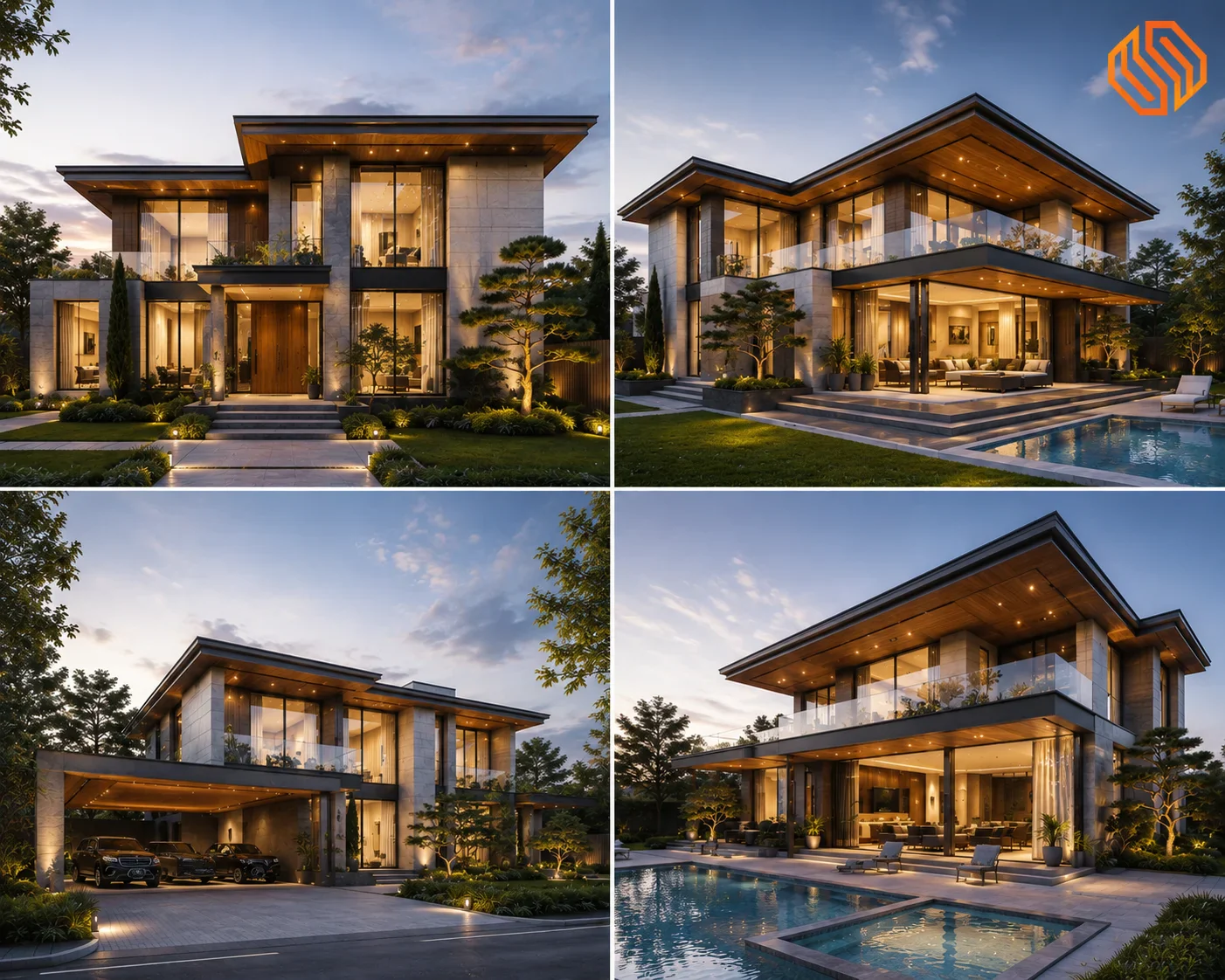
A studio shouldn’t be judged by its best image alone. When you outsource rendering, you need to know whether the provider holds the same visual and technical standard across every deliverable, especially on a project with multiple views or recurring work.
Consistency is often more valuable than one exceptionally impressive render.
Compare Multiple Images From the Same Project
Start by looking at several images from one project rather than judging individual portfolio pieces in isolation.
Check whether the lighting, materials, landscaping, furniture, camera treatment, and post-production stay consistent from one view to the next. If one image looks highly polished while others show noticeably weaker modeling or lighting, that can point to quality varying by artist or by how much production time was available.
For a large architectural project, this matters because your final images will likely be presented together differences in color, lighting, or material appearance can make the set feel visually disconnected.
Look for Consistency Across Different Projects
After comparing images within one project, widen the view to the full portfolio.
You’re trying to find the company’s normal quality level, not just its strongest showcase work. Notice whether the studio holds a similar standard across different project types, artists, and image styles.
A portfolio with several consistently strong projects tends to be more reassuring than one built around a few extraordinary images surrounded by weaker ones.
Check Whether Quality Holds Up at Different Image Types
Quality should stay consistent as the type of image changes. A studio might produce excellent daytime exterior renders but weaker interiors, nighttime scenes, aerial views, close-up details, or technical product shots. If your project needs several types of visualization, make sure the portfolio actually demonstrates each one.
This matters most for ongoing work you don’t want to discover halfway through a project that the team is far stronger in one type of visualization than another.
Pay Attention to Technical Consistency
Visual quality is only one part of consistency. Technical accuracy needs to stay stable too.
Watch for recurring issues such as incorrect proportions, inconsistent material scale, repeated assets, unrealistic reflections, floating furniture, inconsistent vegetation, or façade details that shift between views.
A mistake in one image may just be an isolated error. The same mistake showing up repeatedly points to a production or quality-control problem.
Ask What Quality Control Looks Like
If you’re considering a provider for recurring or high-volume work, ask how final images are reviewed before delivery.
A dedicated QC stage catches problems that are easy to miss during production, especially when several artists are working on the same project. Processes vary between studios, but a good provider should be able to explain concretely how it checks for visual consistency, technical accuracy, missing details, and compliance with the original brief not just say that someone looks it over.
Consistency Matters More as Your Workload Grows
For a single image, you might accept a provider whose quality depends heavily on which artist is assigned. That becomes far riskier once you need ten, twenty, or more images across multiple projects.
At higher volumes, you need repeatable standards, not individual artistic judgment alone. The strongest outsourcing partner isn’t necessarily the one capable of your most spectacular single image it’s the one that produces good work consistently, even as the workload grows.
How Important Is Communication When Outsourcing 3D Rendering?
Communication is one of the most important factors in choosing an outsourcing partner, particularly on projects with multiple revisions, stakeholders, or tight deadlines. A technically skilled studio can still be difficult to work with if it misreads instructions, doesn’t raise questions, or gives unclear updates.
Good communication isn’t about frequent messages. It’s about getting the right information at the right stage so production keeps moving without unnecessary back-and-forth.
Pay Attention to the First Conversation
The initial discussion tells you a lot about how a studio works.A capable team asks about your drawings, references, camera angles, materials, design intent, image requirements, and deadlines whenever those details are relevant. If a provider just accepts the files without checking whether the brief is complete, problems tend to surface later during production.
This matters most when your project has incomplete drawings, changing designs, or visual requirements that can’t be understood from technical files alone.
Look at How They Handle Unclear Requirements
Good communication includes knowing when to ask.If a material reference is missing, two drawings conflict, or the camera position isn’t defined, the team should flag it before production instead of guessing and moving ahead. A useful partner doesn’t ask questions for the sake of it, it asks the ones that prevent avoidable rework.
Evaluate How Feedback Is Understood
Communication quality becomes even clearer during revisions.Give specific feedback and see whether the next version actually addresses it. If your team keeps having to repeat the same correction, the issue may not be rendering skill it may be how feedback is being interpreted or managed.
On larger projects, it also helps if feedback is consolidated rather than arriving from several people independently. That avoids conflicting instructions and makes it easier for the team to identify the latest approved direction.
Ask How Project Updates Are Handled
You should also know how progress updates will reach you. Some projects need frequent previews, others only need updates at set milestones what matters is knowing when to expect communication and who owns it.
If your team regularly has to ask what’s the status of this render?, the process isn’t working as efficiently as it should.
Consider Who Will Be Your Main Contact
For recurring work, having one clear point of contact makes a real difference.You should know who receives your instructions, who coordinates the artists, and who resolves problems. When several people are involved with no clear ownership, information tends to get fragmented.
A dedicated project manager or clearly assigned contact is especially valuable when your projects involve multiple images, reviewers, or overlapping deadlines.
Communication Should Become Easier Over Time
One of the best signs of a good outsourcing relationship is whether the amount of explanation needed drops as more projects are completed. Once a team understands your visual style, briefing format, and approval preferences, later projects should need far less hand-holding. It’s the same accumulated-understanding effect covered earlier, and you can see how we structure that ongoing process on our How We Work page.
How Do You Evaluate 3D Rendering Turnaround Time?
Turnaround time should be judged by reliability, not simply by the fastest delivery a studio promises. A realistic deadline that’s consistently met is worth more than a three-day promise that regularly slips to five or six.
When comparing providers, ask how long projects of similar complexity normally take. A single interior render, a detailed exterior, and a multi-image development each carry very different realistic timelines treat any quote that doesn’t distinguish between them with some caution.
Also clarify when the quoted timeline actually starts. Does it begin when files are received, once the brief is approved, or after all references and materials are available? Getting this straight prevents scheduling misunderstandings later.
Pay attention to when you’ll see the first preview, too. An early preview gives you a chance to catch major problems with camera angles, modeling, materials, or lighting before the final render is produced.
Revisions affect delivery as well. A minor material adjustment is very different from changing a camera angle or redesigning part of a scene, so ask how the studio handles that impact on schedule.
For recurring work, ask how the team manages periods when several projects overlap. A provider can look fast when its workload is light but struggle to hold the same turnaround during busy periods.
From a practical standpoint, I’d choose a provider that quotes five days and consistently hits it over one that promises three but frequently misses.
How Should You Evaluate the Revision Process?
A clear revision process matters because revisions are a normal part of any visualization project. The real question isn’t whether revisions are allowed, but how efficiently the provider handles them without unnecessary delays or extra cost.
Before starting, confirm how feedback is submitted, how many revision rounds are included, and what the company treats as a revision versus a change in scope. Adjusting a material or tweaking lighting is a different thing from changing the camera angle or redesigning part of the scene mid-production.
Fewer revision rounds don’t automatically mean better service. What matters is whether each round actually moves the project closer to approval.
It also helps to know when revisions happen. A provider that shares an early preview gives you a chance to fix major issues before the final high-resolution render and post-production stage.
As with communication generally, a good revision process should need less explanation over time, once the team understands your visual standards and approval preferences.
The right partner makes revisions controlled and transparent, rather than turning every correction into another round of uncertainty.
How Should You Evaluate 3D Rendering Pricing?
Don’t compare providers based on the price per image alone. Instead, look at what’s actually included in the quote, such as modeling, revisions, post-production, resolution, turnaround time, and any additional asset creation.
A low quote can end up expensive if weak work creates extra revisions or your team spends significant time managing corrections. In practice, compare the total cost of reaching an approved final render, not just the sticker price.
For recurring outsourcing, volume matters too. A small gap in the per-image rate can add up fast once you’re ordering dozens of renders a month for example, a $10 difference is easy to ignore on a single image but becomes a meaningful line item across a 40–50 image monthly package, which is why it’s worth asking for a rate card rather than a one-off quote.
Before agreeing to anything, clarify what triggers additional charges: major design changes, extra revision rounds, urgent delivery, or additional modeling.
The best-priced partner isn’t necessarily the cheapest vendor. It’s the one offering predictable cost alongside consistent quality and turnaround.
How Important Is Team Capacity When Choosing a 3D Rendering Partner?
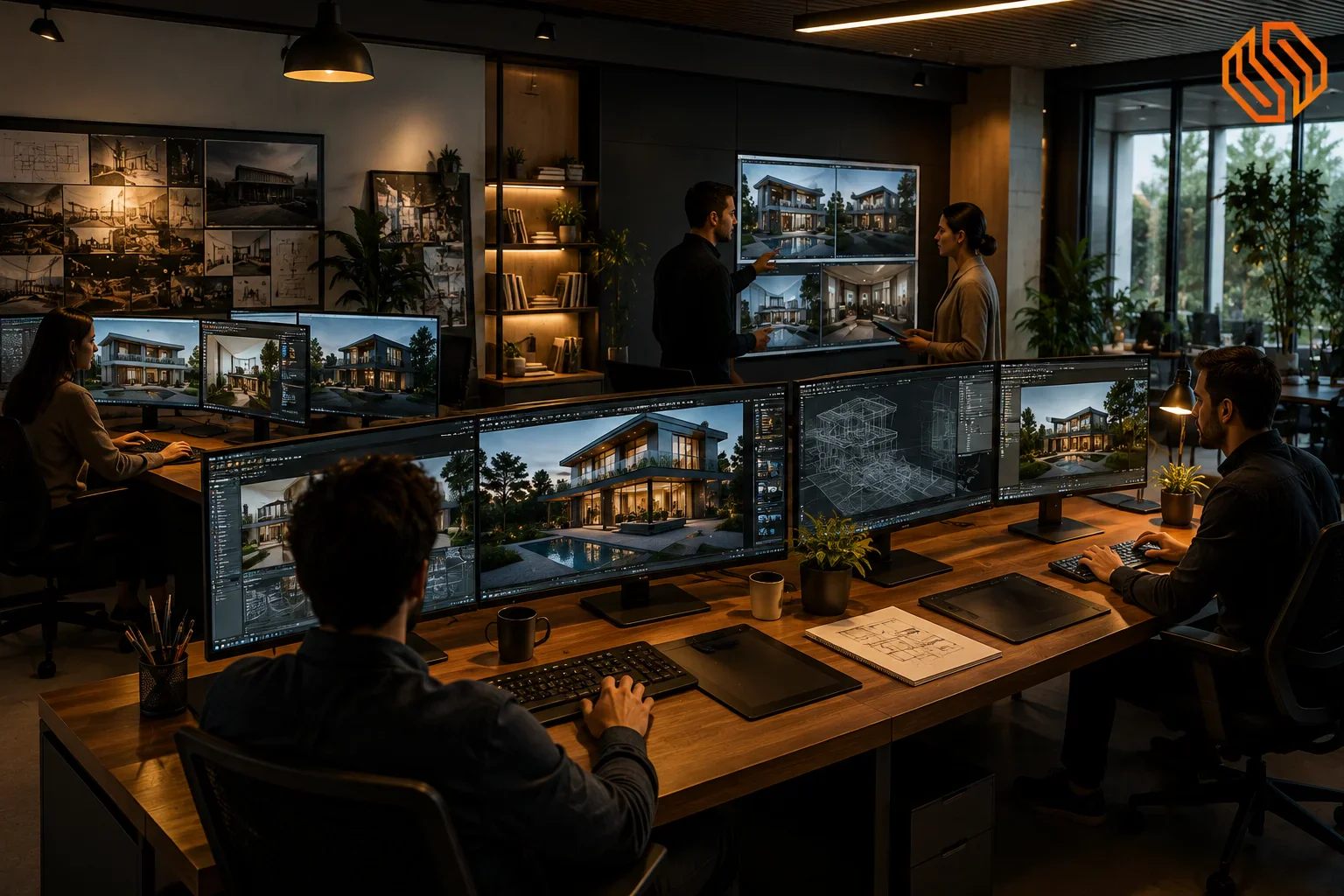
Team capacity matters once your workload is recurring, urgent, or high-volume. A studio can produce excellent work for one project and still struggle when several arrive at once.
Ask whether the company has enough artists and project-management support to handle your expected workload without cutting quality or stretching deadlines. For larger accounts, also confirm who manages your projects and whether backup capacity exists when demand increases.
From a practical standpoint, don’t assume a bigger team is automatically better. A smaller, specialized studio can be a stronger fit for a limited number of complex renders. A larger production team may suit consistent, high-volume outsourcing better.
How Can You Check a 3D Rendering Company’s Reputation?
A company’s reputation helps confirm whether its portfolio and claims match what previous clients actually experienced. Look past star ratings. Focus on feedback about communication, deadlines, revisions, quality, and long-term reliability.
Testimonials, case studies, and references are useful. You can see how we document real project outcomes on our case studies page but specific evidence carries more weight than generic praise. A comment describing how a company handled a difficult project or a tight deadline tells you more than “great service.”
Also look for signs of repeat business. If clients keep coming back for multiple projects, that usually says the company performs well beyond the first render.
For higher-value outsourcing, consider asking the provider for a relevant client reference or a comparable project example. That gives you a chance to verify how the team actually works before making a bigger commitment.
Reputation should support your evaluation, not replace it. A strong review profile can’t make up for an unsuitable portfolio, weak communication, or a poor project fit.
Should You Run a Test Project Before Choosing a 3D Rendering Partner?
Yes. A small paid test project is one of the best ways to evaluate a partner before committing to larger work.
Use a representative brief and assess the actual workflow: how well the team understands it, asks questions, follows references, handles revisions, meets the deadline, and holds quality.
Also measure how much management your team has to provide. A provider that delivers strong work with minimal supervision is often more valuable than one with a slightly better portfolio but a difficult workflow.
The goal isn’t only to confirm what the company can produce. It’s to confirm how reliably and efficiently it can work with your team.
What Mistakes Should You Avoid When Choosing a 3D Rendering Partner?
One common mistake is choosing a company based only on its most impressive portfolio image or its lowest quote. Neither tells you how reliably the provider will perform on your actual project.
Another is ignoring project-specific experience. A studio might produce excellent renders but have little history with your type of architecture, product, technical requirements, or project volume.
It’s also risky to skip questions about revisions, turnaround, pricing, and workflow before production begins. Unclear expectations here tend to lead to extra costs, delays, and unnecessary management.
Finally, don’t commit to a large arrangement without testing the workflow first, especially for an important or recurring project. A small test can reveal communication and production problems that a portfolio never will.
The safest approach: evaluate the quality of the work, the relevance of the experience, the reliability of the process, and the total cost of working with the provider not just how good the final image looks.
How Do You Choose the Right 3D Rendering Outsourcing Partner?
Choosing the right partner comes down to fit, not simply finding the best portfolio or the lowest price. Look for relevant experience, consistent quality, a clear workflow, reliable communication, realistic turnaround times, transparent pricing, and enough capacity for your workload.
Before making a long-term commitment, compare providers against the requirements of your actual project and, where possible, run a small test project.
From a practical standpoint, prioritize relevant experience and consistent delivery over impressive marketing claims. A partner that understands your work, handles feedback efficiently, and delivers predictable quality will usually create more value than a cheaper provider that needs constant supervision.
If your projects require professional 3D architectural rendering, you can review our service page to see how it fits into a broader visualization workflow.