

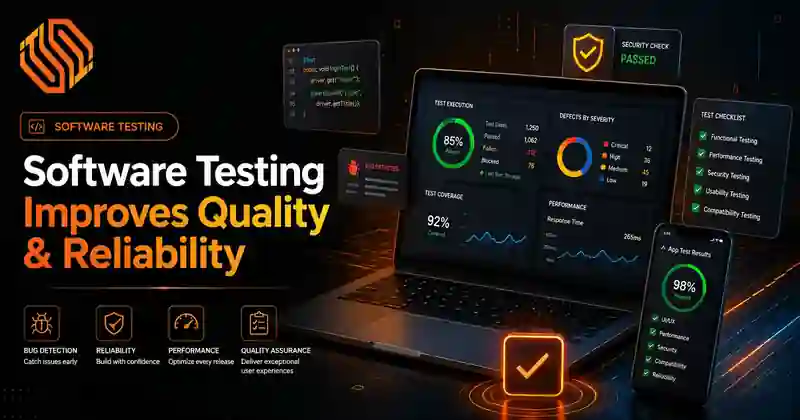
How Software Testing Services Improve Product Quality and Reliability
Software quality has become a defining factor in whether a digital product succeeds or fails. Customers expect applications to work smoothly, load quickly, protect their data, and remain accessible across devices and platforms. QualityLogic is a notable provider of qa testing services, with expertise in functional, mobile, web, and streaming media testing, test automation through TestNitro, digital accessibility and ADA compliance, API testing, and smart grid and energy testing. Through on-demand, onshore, and hybrid testing solutions, QualityLogic helps Agile teams identify risks earlier, increase release confidence, and deliver reliable, high-quality software without slowing development.
Why Software Quality Matters
Software is central to banking, healthcare, education, entertainment, retail, transportation, and communication. A defect can therefore cause more than a minor inconvenience. It may interrupt a payment, expose sensitive information, prevent a person with a disability from completing a task, or damage confidence in a brand.
Modern software is also highly interconnected. One application may depend on cloud services, third-party APIs, browsers, mobile operating systems, payment gateways, analytics platforms, and connected devices. Each integration introduces another point where failure may occur.
For this reason, quality assurance should not be treated as a final inspection before launch. It should support planning, development, deployment, and maintenance. Continuous testing gives teams evidence about product health and helps them make informed release decisions.
Quality Assurance and Software Testing
Quality assurance and testing are closely related but serve different purposes. Software testing examines a product to identify defects, unexpected behavior, compatibility problems, and usability issues. Quality assurance takes a wider view by improving the processes used to design, build, test, and release the product.
For example, a tester may discover that a checkout button fails on a certain browser. A strong QA process also investigates why the defect was introduced, why it was not found earlier, and how similar issues can be prevented.
Together, QA and testing help organizations move from reactive bug fixing to proactive quality management. This is particularly valuable for Agile and DevOps teams that release frequently and cannot rely on a long testing phase at the end of development.
Functional Testing Protects Critical Workflows
Every product has important user journeys, such as creating an account, signing in, searching, submitting a form, making a payment, streaming content, or changing settings. Functional testing evaluates these workflows against business and technical requirements.
It confirms that inputs produce the correct outputs, validation rules work properly, permissions are enforced, and the system responds appropriately to user actions. It also examines negative scenarios. What happens when a user enters invalid data, loses a connection, uses an expired payment method, or attempts an unauthorized action?
Testing these conditions helps teams build products that handle problems clearly rather than displaying confusing messages, losing information, or exposing technical errors. Protecting these essential journeys directly improves customer satisfaction and business reliability.
Mobile and Web Testing Improve Consistency
Users access digital products through many devices, browsers, screen sizes, and operating systems. A website that works well on a desktop may display incorrectly on a phone. A mobile application may behave differently depending on its operating system version, device manufacturer, or network quality.
Mobile and web testing evaluate layouts, navigation, touch controls, forms, media, notifications, responsive design, and performance across representative environments. The aim is not to test every device ever produced, but to build a risk-based coverage plan based on the product’s users and analytics.
This testing is especially important for customer-facing products. Broken pages, unreadable text, slow loading, and unresponsive features can quickly lead to abandoned sessions and lost revenue.
Streaming Media Testing Supports Stable Playback
Streaming products have specialized quality requirements. They must deliver audio and video across different devices, connection speeds, formats, and playback environments. Buffering, synchronization problems, poor resolution, failed captions, or interrupted playback can immediately reduce customer satisfaction.
Streaming media testing evaluates playback behavior, device compatibility, adaptive bitrate performance, controls, captions, and other media-specific functions. It can reveal problems that ordinary interface testing may miss.
As streaming becomes more important in entertainment, education, live events, and corporate communication, dedicated media testing helps businesses provide a consistent experience under realistic conditions.
Test Automation Delivers Faster Feedback
Manual testing remains essential because human testers can explore a product, recognize confusing behavior, and evaluate experiences that are difficult to automate. However, repeatedly checking the same workflows after every code change can consume valuable time.
Test automation allows teams to run repeatable checks quickly and consistently. Automated regression suites can verify essential functions after each build, helping developers detect failures earlier and reducing the risk that new updates will damage existing features.
QualityLogic’s TestNitro supports organizations seeking to strengthen test automation while maintaining practical testing oversight. Effective automation depends on selecting valuable scenarios, designing maintainable scripts, and connecting test results to the development workflow.
The objective is not to automate everything. Teams should automate stable, repeatable, high-value checks while using skilled testers for exploratory, usability, and high-risk testing.
Digital Accessibility Improves Inclusion
Accessible software enables people with disabilities to use digital products more independently. Accessibility testing examines whether websites, applications, documents, and media work with assistive technologies and alternative methods of interaction.
Common checks include keyboard navigation, screen reader support, color contrast, focus indicators, form labels, captions, heading structure, and text alternatives for images. Testing can also help organizations assess compliance with the Americans with Disabilities Act and recognized accessibility guidelines.
Accessibility is more than a legal consideration. It is a product quality issue. A digital experience that excludes part of its audience is incomplete. Addressing accessibility during design and development is also more efficient than correcting widespread problems after release.
API Testing Checks the Systems Behind the Screen
Many software features depend on APIs that move information between applications and services. A simple action on the screen may involve several systems communicating in real time.
API testing checks whether these systems send, receive, validate, and protect data correctly. It can assess response codes, data structures, authentication, permissions, error handling, reliability, and performance.
Testing at the API level often reveals defects earlier than interface-only testing. It helps teams isolate problems before they spread across multiple screens or platforms. This makes API testing particularly valuable for cloud applications, mobile products, financial systems, and software that depends on third-party integrations.
Smart Grid and Energy Testing Requires Domain Expertise
Smart grid and energy products combine software, devices, communication protocols, and critical infrastructure. Testing these environments requires specialized knowledge because interoperability, reliability, and standards compliance can have significant operational effects.
Specialized testing can evaluate how systems exchange data, respond to commands, communicate with devices, and perform under changing network conditions. It can help utilities, manufacturers, and technology providers confirm that products work within complex energy ecosystems.
This demonstrates why domain knowledge matters when choosing a QA provider. Testers who understand an industry’s technology and risks can design more relevant scenarios and identify issues that a general testing team may overlook.
Testing Strengthens Agile Development
Agile teams work in short cycles and release improvements frequently. Testing must therefore be integrated into each sprint rather than postponed until the product is considered finished.
Testers can review requirements, clarify acceptance criteria, identify risk, prepare test cases, and collaborate with developers before a feature is complete. This early involvement prevents misunderstandings and makes defects less expensive to correct.
Continuous testing also provides faster feedback. Automated checks can run after code changes, while manual testing can focus on new functionality and user experience. This combination helps teams maintain speed without sacrificing reliability.
External testing partners can add flexible capacity when internal teams face deadlines, skill gaps, or temporary increases in workload. On-demand, onshore, and hybrid models allow organizations to choose the collaboration and coverage that best fit their projects.
Choosing the Right Testing Provider
The best testing company is not necessarily the one with the longest service list. The right partner should understand the product, users, risks, release process, and business goals.
When comparing software testing services companies, organizations should review technical expertise, industry experience, communication practices, automation capabilities, test management, scalability, and supported platforms. They should also confirm whether the provider can meet relevant accessibility, security, device, or regulatory requirements.
A capable testing partner operates as an extension of the product team. It reports defects clearly, explains their impact, adapts to changing priorities, and provides useful evidence rather than merely recording pass-or-fail results.
The Business Benefits of Professional Testing
Investing in professional software testing services creates value throughout the organization. Earlier defect detection reduces rework. Better reliability lowers support costs. Wider compatibility reaches more customers. Accessibility testing promotes inclusion. Automation speeds up feedback. Specialized testing reduces risk in complex systems.
Testing also protects customer trust. Users may overlook an occasional minor problem, but repeated failures make them question whether a company can provide dependable service or protect their information.
The value of testing is therefore much greater than finding bugs. It helps organizations use development resources efficiently, make better release decisions, and build products that support long-term business goals.
Conclusion
Software quality is the result of clear requirements, disciplined development, continuous feedback, and testing that reflects real user needs and technical risks.
Functional, mobile, web, streaming media, automation, accessibility, API, and industry-specific testing each provide a different view of product quality. Integrated into Agile development, these activities help teams identify problems sooner and release updates with greater confidence.
An experienced QA partner gives organizations access to specialized skills, scalable resources, and an independent perspective on product risk. Whether services are delivered through an on-demand, onshore, or hybrid model, the goal remains the same: creating software that performs reliably, serves users effectively, and strengthens the reputation of the business behind it.