

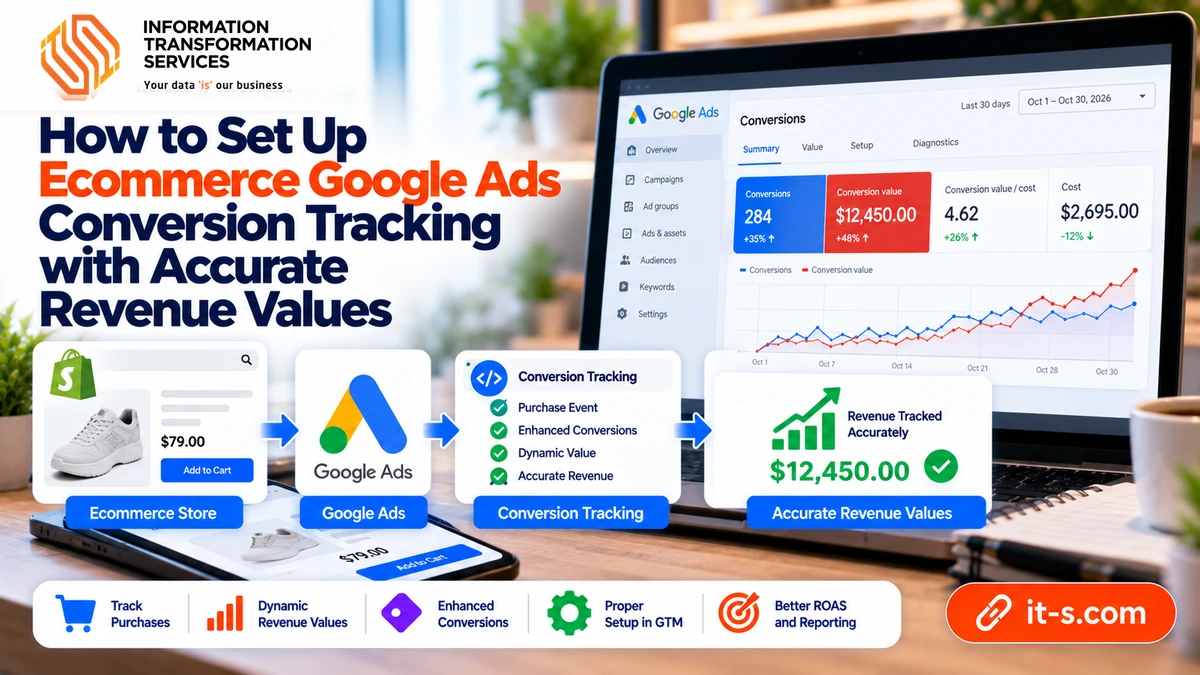
How to Set Up Ecommerce Google Ads Conversion Tracking With Accurate Revenue Values
Google Ads can optimize only toward the conversion signals it receives. If an ecommerce store records every purchase as the same value, misses transactions, duplicates orders, or counts low-value actions as primary conversions, automated bidding may learn from the wrong outcomes. The campaign can appear active and data-rich while still making poor budget decisions.
Reliable ecommerce conversion tracking should connect ad clicks to real business outcomes such as completed purchases, revenue, qualified leads, subscriptions, or other actions that matter financially. The goal is not simply to collect more conversion events. It is to send accurate, deduplicated, appropriately valued data back into the advertising platform so campaign decisions reflect actual performance.
Define the Primary Business Conversion First
Before adding tags, decide which action represents success for the campaign. For a typical ecommerce store, the primary conversion is a completed purchase. Add-to-cart, checkout start, product views, and newsletter signups may still be useful signals, but they should not automatically be treated as equivalent to revenue-generating orders.
Separating primary and secondary actions prevents optimization from chasing easy micro-conversions at the expense of actual sales. A campaign with thousands of cart additions but few completed orders should not look more successful than one generating profitable purchases.
Pass Dynamic Purchase Values Instead of a Fixed Number
If orders have different values, the conversion tag should send the actual transaction value rather than one fixed amount for every sale. A $20 order and a $500 order are not equally valuable to the business, and value-based bidding needs that difference to make sensible decisions.
The purchase event should include the order value in a consistent numeric format and the correct currency. If taxes, shipping, discounts, or refunds materially affect profitability, decide in advance which components should be included so reporting stays consistent.
Use a Unique Transaction ID to Prevent Duplicate Purchases
Duplicate conversion counting can happen when a customer reloads the thank-you page, revisits the order confirmation, or fires both browser-side and server-side tracking without deduplication. A unique transaction or order ID helps the system recognize that repeated signals belong to the same purchase.
Use the actual ecommerce order identifier where possible. The ID should be stable, unique, and sent with the purchase event. This is one of the most important quality controls because duplicated revenue can make return on ad spend look much stronger than reality.
Trigger the Purchase Event Only After the Order Is Confirmed
Do not record a purchase merely because a shopper reached the final checkout step. The conversion should fire only after the store confirms that the order was successfully created according to the business’s payment and order rules.
For some stores, payment is confirmed immediately. Others may use delayed payment, bank transfer, or fraud checks. The tracking design should match the actual transaction process so abandoned or failed orders do not inflate conversion counts.
Keep Currency Handling Consistent
Multi-currency stores need special attention. If order values are sent in several currencies without correct currency codes, aggregate revenue can become misleading. Each purchase should clearly communicate both the numeric value and the currency used for that transaction.
If internal reporting converts everything to one base currency, document the conversion logic and keep it separate from raw order values. Consistency between ad-platform data and ecommerce reporting makes reconciliation easier.
Distinguish Revenue From Profitability
Conversion value usually represents revenue, but not every dollar of revenue produces the same margin. A campaign selling high-revenue, low-margin products can appear efficient even when profit is weak.
Where the business has reliable cost data, consider whether value adjustments or offline processes should reflect margin, customer quality, or another meaningful business metric. At minimum, compare Google Ads revenue reporting with internal profitability rather than assuming ROAS alone tells the full story.
Track Important Micro-Conversions as Secondary Signals
Product views, add-to-cart events, checkout starts, account creation, and email signup can help diagnose the funnel. They show where users are progressing or dropping out, but they should normally remain secondary when purchases are the main business goal.
This distinction becomes especially important in campaigns that use automation. The article on predictive AI and expert Google Ads management explains why automated systems need clean business signals and human oversight rather than a large collection of poorly prioritized events.
Test the Entire Purchase Journey Before Launch
A tag that appears correctly in a configuration screen may still fail during a real order. Place test orders from an ad-like session and confirm that the purchase event fires once, carries the correct value, uses the correct currency, and includes the intended transaction ID.
Test different scenarios such as discounts, shipping fees, multiple products, guest checkout, logged-in checkout, and different payment methods. Edge cases often reveal tracking problems that a single ideal test order will miss.
Compare Ad-Platform Revenue With Store Revenue
Google Ads should not be expected to match total store revenue because attribution scopes differ, but tracked purchases should still be reconciled with the ecommerce platform. Large unexplained gaps can indicate missing tags, duplicated transactions, consent effects, cross-domain issues, or attribution differences that need investigation.
Create a recurring reconciliation process. Compare transaction counts, values, and known order IDs for a defined period rather than relying only on dashboard totals.
Watch for Cross-Domain Checkout Problems
Some stores send users to a different domain or payment environment during checkout. If the advertising click identifier or analytics session is lost during that transition, the purchase may appear unattributed even though the customer originally arrived from an ad.
Review the full domain path from landing page to order confirmation. Where multiple domains are involved, configure tracking so the user journey remains connected according to the platform and consent requirements.
Treat Consent and Privacy as Part of Measurement Design
Tracking must respect the site’s privacy obligations and consent setup. If tags are blocked until consent, the measurement system should account for that behavior rather than assuming every visitor can be tracked identically.
Coordinate advertising tags, analytics, cookie controls, and privacy settings instead of configuring them independently. Measurement quality and compliance should be designed together from the start.
Use Enhanced Matching Signals Only With Clean Customer Data
First-party customer information can improve the platform’s ability to associate conversions with prior ad interactions when implemented appropriately. However, these signals should come from valid customer-provided data and follow the platform’s required formatting and privacy rules.
Normalize input consistently and avoid sending placeholder, test, or malformed values. Bad first-party data does not become useful simply because it is hashed or automated.
Separate New Customer and Returning Customer Analysis
A purchase from a new customer may have different strategic value from a repeat order. If the store can distinguish customer type reliably, analyze campaigns by acquisition and repeat behavior rather than treating every transaction identically.
This does not require changing the core purchase conversion immediately. Start by reporting the difference. Once the business understands lifetime value and margin, bidding strategies can be evaluated against more meaningful customer economics.
Review Attribution Without Treating It as Absolute Truth
Advertising platforms assign credit according to their attribution settings and available data. That does not mean the platform’s number is the only valid view of the customer journey. Email, organic search, direct visits, marketplaces, and other channels may contribute to the same purchase.
Use platform attribution for campaign optimization while comparing it with broader business analytics. A strong SEO and PPC measurement process keeps channel data useful without assuming one dashboard captures the entire decision path.
Monitor for Sudden Tracking Changes
Conversion tracking can break after theme updates, checkout changes, tag-manager edits, app installations, consent-platform changes, or payment-flow modifications. A sudden drop in conversion rate may be a business problem, but it may also be a measurement failure.
Monitor daily purchase counts, conversion values, and transaction-ID behavior. If store sales remain stable while Google Ads conversions collapse, investigate tracking before changing bids or budgets aggressively.
Document the Conversion Architecture
Keep a simple record of which events are tracked, which are primary, where each tag fires, what value is sent, how transaction IDs are generated, and which system is considered the financial source of truth.
Documentation becomes especially valuable when several people manage the website, analytics, and advertising. It reduces the chance that someone creates a second purchase tag or changes a value rule without understanding the effect on optimization.
Conclusion
Accurate ecommerce conversion tracking is the foundation of reliable Google Ads optimization. The most important elements are a clearly defined primary purchase action, real transaction values, unique order IDs, correct currency handling, tested checkout triggers, and regular reconciliation with store data.
More conversion events do not automatically create better campaigns. Better signals do. When purchase data is complete, deduplicated, and aligned with real business outcomes, automated bidding and human campaign management can make decisions from a much stronger representation of what the store actually earns.