

Back Office Automation vs Outsourcing and How to Choose the Right Approach
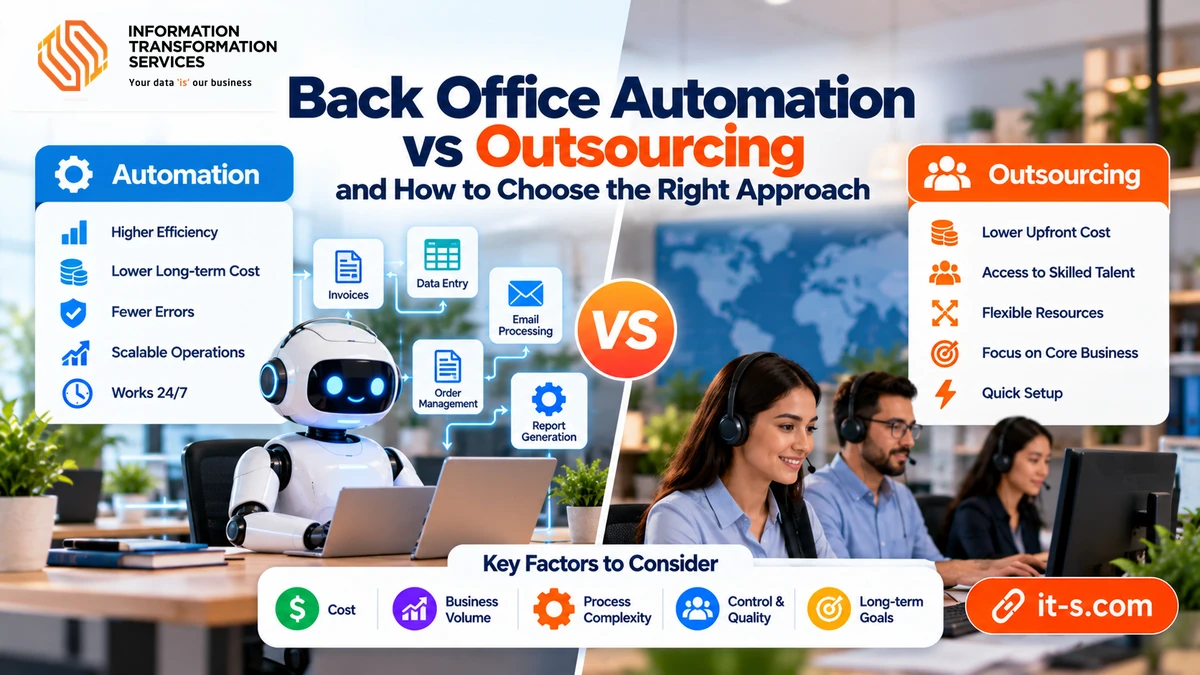
Back-office automation and outsourcing answer different operational questions. Automation changes how repeatable tasks are executed. Outsourcing changes who performs or manages the work. A business can combine them, using technology for stable routine steps and a service team for judgment, exceptions, and variable demand.
The decision should be made at the task level. Treating an entire process as either fully automated or entirely manual hides useful combinations. Document intake, data validation, customer clarification, and final approval may each need a different delivery method even when they belong to the same workflow.
Divide the process by predictability and judgment
Start with a sample of completed work and its exceptions. Identify the steps that follow consistent rules, the steps that require interpretation, and the steps that change frequently. Record the volume and timing of each category rather than use only a monthly total.
Stable repetitive tasks are candidates for automation when the inputs and required outputs can be tested. Work involving ambiguous documents, changing customer instructions, or negotiation often benefits from trained people. Low-volume work may not justify substantial implementation effort even when it is technically automatable.
An outsourcing partner can provide operational capacity and specialist handling across these categories. An automation provider addresses the process and system connections. 2BBooster focuses on business process optimization and automation using RPA, AI, and integrations, which can complement a service team’s delivery responsibilities.
Match the method to a defined step
Consider an illustrative supplier onboarding process. Incoming forms must be collected, classified, checked against required fields, and entered into a business system. Missing information must be requested, and an authorized person must approve the supplier before activation.
Classification and extraction may be automated for document types that perform well in testing. A service team can investigate unclear information and contact the supplier through approved channels. The business retains the decision about whether the supplier meets its approval requirements.
Where a legacy application lacks a suitable interface, RPA for repeatable back-office steps may handle validated data entry. Define what the bot is allowed to change and how it verifies the resulting record. A successful screen interaction is not sufficient evidence that the correct supplier was updated.
Compare the full cost of delivery
For an outsourced service, include setup, training, minimum commitments, volume bands, quality review, and internal coordination. Clarify which exceptions are included and which require additional handling. A low price per item can be misleading if the comparison excludes difficult items or customer follow-up.
For automation, include implementation, licenses, infrastructure, support, monitoring, and human exception work. Application changes can create maintenance needs. The cost of supervising automation belongs in the comparison, even if that work is performed by existing employees.
Compare cost per correctly completed item under the same service requirements. Include rejected or reworked items in the accounting so they do not disappear from the denominator. Separately consider speed, capacity during peaks, and the business impact of delayed completion. These factors may matter even when direct cost is similar.
Write the handoff rules before the service begins
A combined model needs clear boundaries. Define what automation sends to the service team, what evidence accompanies it, and what the team can correct. Specify when an item returns to the business for a decision rather than move through another round of processing.
For supplier onboarding, an exception packet could contain the original form, extracted values, failed checks, and the relevant supplier identifier. The reviewer then has the context needed to act. Sending only a generic failure message forces the team to reconstruct work already performed.
Record approval authority separately from processing responsibility. Access should reflect the assigned task, and activity should be attributable to the responsible person or automation account. Agree how credentials, documents, and unresolved work are handled when the service arrangement changes.
Test the combined model under ordinary pressure
Run a pilot that includes routine work and a realistic share of exceptions. A sample containing only clean documents will not reveal how the delivery model behaves when information is incomplete or a receiving system is unavailable.
Measure turnaround time by category, acceptance quality, rework, and the age of unresolved items. Record whether delays occur in extraction, review, customer clarification, or approval. That distinction guides improvements more effectively than a single overall average.
Test the fallback when automation stops. The service team should know which items remain incomplete and how to prevent duplicate entry when processing resumes. Also test a volume spike and the absence of a key approver. Capacity planning should include the review queue, which can become the constraint after routine entry accelerates.
Common Questions About Automation and Outsourcing
Can outsourcing come before automation
Yes. A service team can help establish consistent procedures and reveal recurring exceptions. Preserve process knowledge and measurements so later automation decisions are based on observed work.
When is a combined approach unnecessary
A simple low-volume task may be handled adequately by one internal employee or an existing service arrangement. Add automation when the expected operational benefit justifies its setup and ongoing oversight.
Final Thoughts
The useful comparison is between delivery models for specific work, with the same quality and service expectations. Some steps suit repeatable execution; others need people who can interpret an exception and obtain missing information. Outsourcing and automation can support each other when their handoffs are explicit and the business retains appropriate decision authority. Test that arrangement on representative work, including failures and peaks, before expanding it. The aim is a process whose cost, ownership, and unfinished items remain understandable as demand changes.
Where document intake drives the workload, an assessment of document extraction and validation can help define what technology should handle and what reviewers should retain. Use representative files and current exception records to scope a pilot that fits the responsibilities of the business and its service partners.