


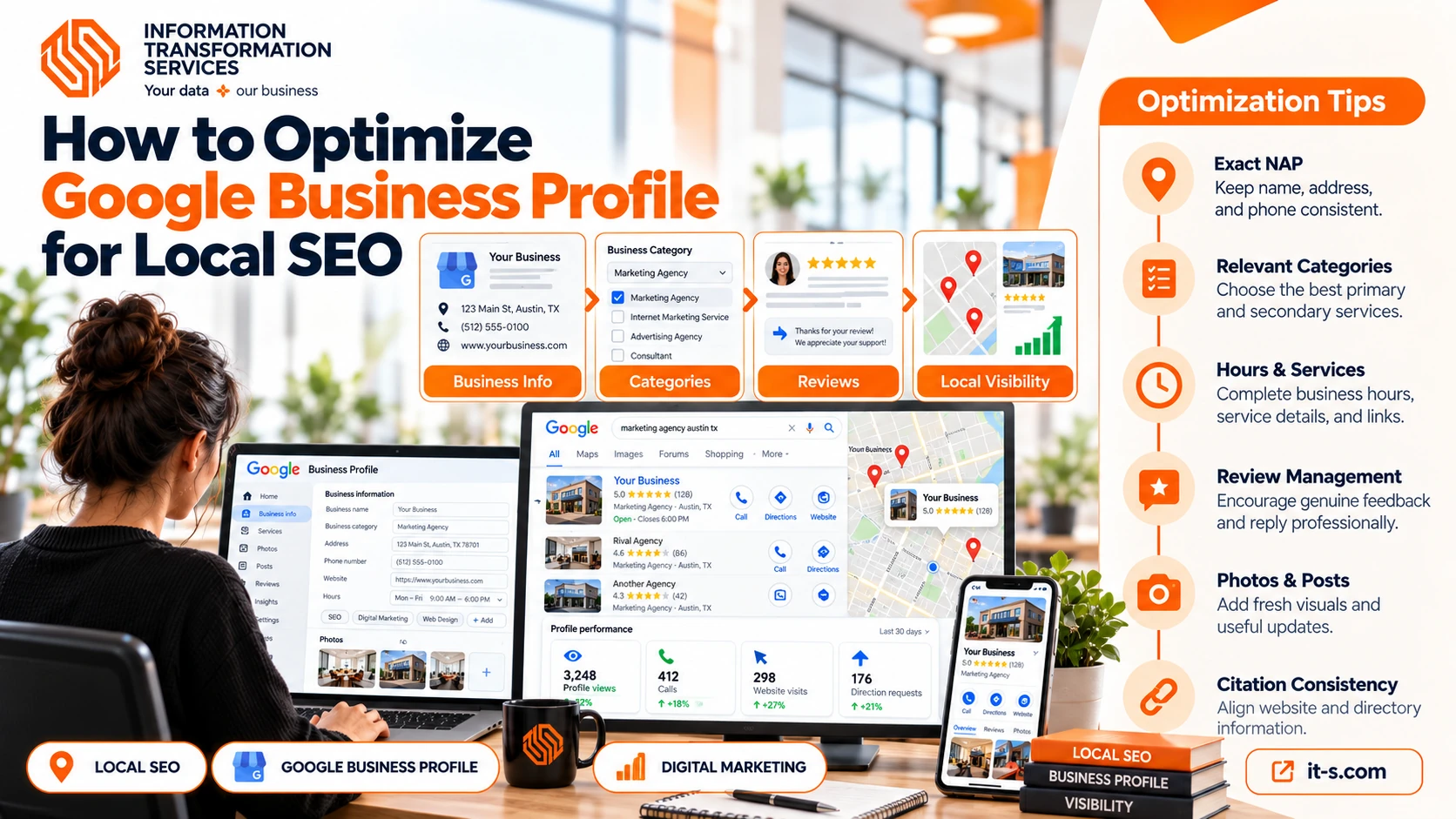
How to Optimize Google Business Profile for Local SEO
For a business that depends on customers in a specific city or service area, Google Business Profile can be one of the most visible parts of local search. A well-maintained profile can appear when people search for a business name, a service near them, or a category such as “3D modeling services,” “data entry company,” or “image editing service.” The profile itself does not replace a website, but it gives Google structured information about the business and gives searchers quick access to hours, contact details, reviews, photos, directions, and other decision-making information.
Optimization should therefore focus on accuracy, completeness, relevance, and consistency rather than on stuffing keywords into every field. Google states that local results are mainly influenced by relevance, distance, and prominence. Distance cannot be manipulated, but the other signals can be supported by accurate business information, a clear category choice, a useful website, legitimate reviews, and consistent information across the web. The objective is to make the profile easier for both users and search systems to understand.
Use the Exact Business Identity Everywhere
Start with the business name, address, phone number, website, and service area. These details should match how the business is represented in the real world and on its own website. Adding extra keywords to the business name may look tempting, but it can create inconsistency and may conflict with Google’s representation guidelines. The safer approach is to use the genuine business name and communicate services through the category, description, website content, products, services, and posts.
For businesses with a storefront, confirm that the address is precise and that the map pin is positioned correctly. For service-area businesses, define the areas actually served instead of adding locations simply to broaden reach. If a phone number changes, update it everywhere rather than allowing old and new versions to coexist. Google can assemble business information from several sources, so conflicting details on the website, directories, and profile can make the entity harder to interpret. Google’s Business Profile representation guidelines are worth checking whenever the business name, location model, or service area changes.
Choose Categories for Relevance Rather Than Volume
The primary category is one of the clearest ways to describe what a business actually is. Select the category that most closely reflects the main service customers would expect to receive. Secondary categories can cover important additional services, but adding loosely related categories can dilute the profile instead of strengthening it. A company focused on digital production, for example, should not choose a broad technology category when a more precise service category is available.
Category decisions should be reviewed whenever the business changes its core offering. They should also align with the language used on the website. If the profile emphasizes one service while the corresponding page barely explains it, the overall relevance signal is weaker. This is where on-site optimization matters. A dedicated page such as the SEO and PPC services page can support a profile by clearly describing the service in a crawlable, structured context without turning the Business Profile itself into a block of keyword-heavy text.
Complete the Fields That Help Searchers Make Decisions
A profile should answer the common questions a searcher would otherwise need to visit several pages to resolve. Keep regular hours accurate, add special hours for holidays or temporary closures, select the correct business attributes, and ensure that the website link leads to the most useful destination. If appointment, order, reservation, or service links are available for the business type, use the correct destination instead of a generic homepage whenever possible.
The description should explain what the business does in straightforward language. It can mention core services, customers served, and distinguishing operational details, but it should not read like an advertisement. Avoid excessive capitalization, unsupported superlatives, repetitive location names, or long lists of keywords. The same principle applies to service entries. Add real services with clear names and useful explanations so people can understand what is offered before they contact the business.
Treat Reviews as Customer Feedback and Local Search Data
Reviews influence how people evaluate a local business, and Google also identifies review quantity and positive ratings as signals associated with local prominence. The productive strategy is not to chase a perfect score but to build a steady flow of genuine feedback from real customers. Ask for reviews at appropriate points in the customer journey, make the process easy, and never offer incentives that distort the authenticity of the feedback.
Responses matter because they show that the profile is actively managed. Thank customers for useful feedback, answer factual questions, and handle criticism calmly without revealing private information. A response does not need to contain target keywords. In fact, forcing service and city terms into every reply makes the language unnatural. Reviews are most useful when they naturally describe what customers experienced. The broader relationship between reviews and discoverability is also covered in the article on the role of online reviews in SEO.
Use Photos to Improve Trust and Context
Photos do not need to be highly produced advertisements. They should help a potential customer understand the business, its environment, its work, or its team. For a physical location, useful images may include the storefront, entrance, interior, parking context, or signage. For a service business, images can show completed work, equipment, workflows, before-and-after examples, or other relevant visual evidence that does not expose confidential client information.
Keep images current and representative. A profile filled with old branding or outdated facilities can create uncertainty even if the contact information is correct. Avoid uploading near-duplicate images only to increase the count. Quality, variety, and usefulness are more important than volume. Google also maintains specific photo, video, and post content policies, so images and updates should remain factual and compliant rather than promotional in a way that could be considered misleading.
Publish Updates When There Is Something Worth Saying
Business Profile posts can be useful for timely information such as service changes, new opening hours, events, operational notices, new resources, or other updates that help customers. They should not be treated as a substitute for a full content strategy. Repetitive posts with no new information create noise, while concise updates tied to real changes can make the profile more useful.
When a website publishes a detailed article, a Business Profile update can direct interested users to that resource, provided the post accurately describes what they will find. For example, a broader article about mobile-first web design and local SEO can support local-search education on the site, while the Business Profile remains focused on practical information about the actual business. Keeping those roles separate avoids turning the profile into a duplicate of the website.
Strengthen the Website Behind the Profile
Google Business Profile optimization works best when the linked website provides clear evidence about the business, its services, and its location. The site should have consistent contact details, a logical page structure, useful service content, fast mobile performance, and pages that clearly match the services represented in the profile. Local SEO is not confined to the Business Profile because prominence and relevance are also influenced by information found elsewhere on the web.
For businesses serving more than one area, avoid creating thin pages that simply swap one city name for another. Each location or service-area page should exist because it provides meaningful information for users. That might include location-specific services, directions, operating details, project examples, or regional considerations. The goal is to make each page genuinely useful rather than to manufacture geographic keywords.
Keep Citations and Business Information Consistent
Business information appears across maps, directories, social profiles, industry listings, local chambers, review platforms, and other sites. Exact uniformity in every punctuation mark is less important than avoiding genuine conflicts. A changed address, disconnected phone number, old website domain, or previous business name can create confusion for customers and search systems. Audit the most visible third-party references periodically and correct outdated details where possible.
Do not create large numbers of low-quality directory listings simply because citations are associated with local SEO. A smaller set of accurate, relevant, trusted references is more useful than hundreds of inconsistent profiles. If the business belongs to professional associations or recognized local organizations, those references can also help establish real-world prominence without relying on artificial link schemes.
Measure Actions Instead of Watching One Ranking
Local rankings change by searcher location, query wording, device, and competitive context. A single manual search from one location therefore gives an incomplete picture. Measure a wider set of outcomes such as calls, website visits, direction requests, appointment actions, messages where available, and conversions on the website. Compare these with search visibility and customer activity over time rather than treating one map position as the only success metric.
Google explains that local ranking is primarily based on relevance, distance, and prominence. That means no optimization method can guarantee the same position for every searcher. A useful measurement process looks for steady improvement in qualified visibility and customer actions while keeping the profile accurate. If impressions increase but calls and website conversions do not, the profile may be appearing for less relevant searches or the business information may not be answering customer needs clearly enough.
Avoid Shortcuts That Can Damage the Profile
The fastest way to make a profile less reliable is to optimize for an algorithm instead of for a real business. Common risky practices include adding unnecessary keywords to the business name, creating duplicate profiles for one location, using virtual offices that do not meet eligibility requirements, displaying inaccurate service areas, generating fake reviews, or repeatedly changing categories to chase visibility. These tactics can produce inconsistent information and may lead to profile restrictions.
A better approach is slower but more durable. Verify the business, represent it accurately, keep important fields current, collect legitimate feedback, maintain a useful website, publish relevant updates, and monitor changes. Optimization then becomes a maintenance discipline rather than a one-time setup exercise.
Conclusion
Google Business Profile optimization for local SEO is mainly about making a real business easy to understand and easy to trust. Accurate identity information, appropriate categories, complete service details, current hours, genuine reviews, useful photos, consistent citations, and a strong website all contribute to that goal. These elements support relevance and prominence, while distance remains dependent on the searcher and the business location.
The strongest profiles are not the ones filled with the most keywords. They are the ones that stay accurate as the business changes and give customers enough information to make a decision. By treating the profile as part of a broader local-search ecosystem rather than an isolated listing, businesses can improve discoverability while keeping the information clear, useful, and aligned with Google’s guidelines.