


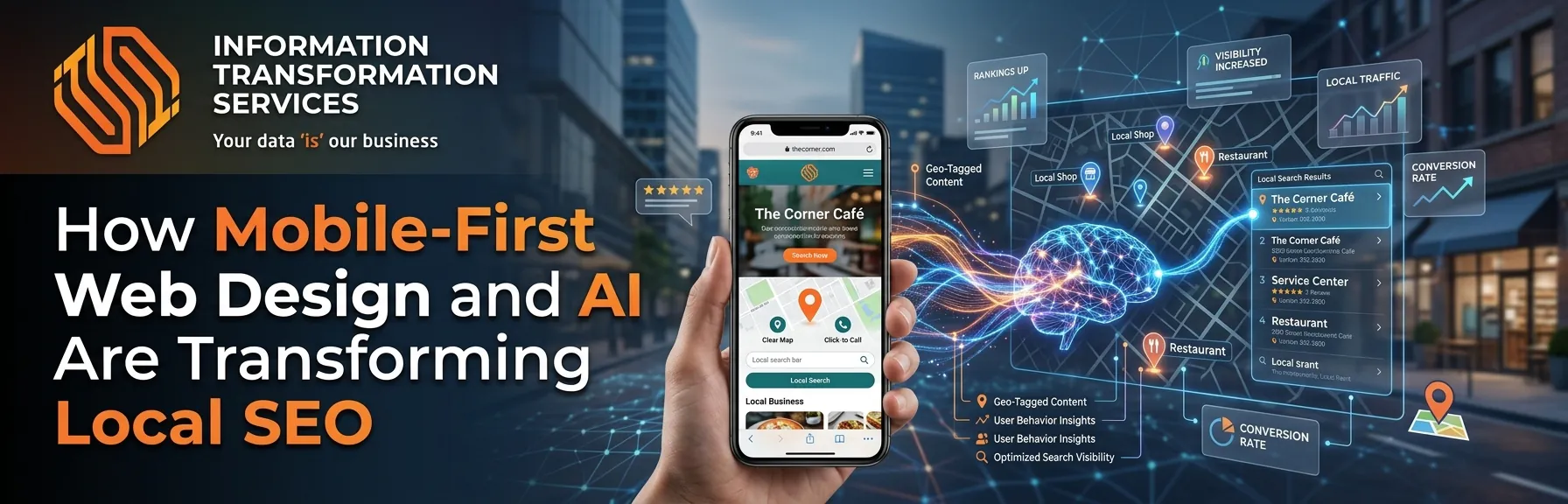
How Mobile-First Web Design and AI Are Transforming Local SEO
The digital landscape is undergoing a massive shift. As search algorithms evolve rapidly, businesses must adapt their online presence to meet new user behaviours and technical requirements. This transformation is driven by two main forces: the absolute dominance of mobile devices and the rapid integration of artificial intelligence into search engines. The intersection of these two technologies is creating a hyper-personalised, highly efficient search ecosystem that rewards technical precision and contextual relevance. Establishing a strong foundation in mobile search optimisation, as often detailed in the foundational SEO resources at Information Transformation Services, is just the beginning. Today, mastering local search requires a deep understanding of how AI algorithms interpret mobile web design and extract meaningful data for users on the go.
The Finality of Mobile-First Indexing
Google has officially concluded its multi-year rollout of mobile-first indexing. This means that every website globally is now crawled, evaluated, and ranked strictly based on its mobile infrastructure. Googlebot Smartphone is now the primary crawler for the vast majority of websites. If valuable content, internal links, or structured data exist on a desktop version but are hidden on the mobile site to save space, they are completely invisible to Google’s index. Websites that fail to render properly on smaller screens will see a direct and significant drop in their organic visibility.
This shift is particularly critical in highly connected regions. For example, Thailand’s digital market has reached near saturation with over 67.8 million internet users, making it a prime example of a mobile-first economy. With the country’s mobile connection penetration hitting 135 percent of the total population and local consumers using massive amounts of mobile data daily, regional businesses must prioritise seamless mobile experiences. Navigating these regional nuances often requires on-the-ground expertise, which is why partnering with a specialised digital marketing agency in Bangkok can provide the localised insights needed for successful regional deployment. Mobile user experience signals are now stringent ranking requirements. Sites with tap targets smaller than 48 by 48 pixels or font sizes below 16 pixels are immediately flagged for critical usability errors. Furthermore, technical website speed evaluations demand a Largest Contentful Paint time of under 2.5 seconds when tested on real-world 4G connections.
AI Overviews and the New Local Search Paradigm
While mobile-first design establishes the technical foundation, generative AI is entirely changing how users discover local services. Search engines are deploying AI overviews that fundamentally alter organic traffic flows by providing direct, conversational answers at the very top of the results page. Generative AI summaries increasingly bypass generic city-wide service pages to pull context from hyper-local neighbourhood data, specialised niche directories, and detailed third-party reviews. Over 35 percent of consumers now report actively using generative AI tools specifically to locate and evaluate local businesses, seeking quick recommendations rather than scrolling through traditional search results.
Modern local businesses can no longer rely solely on traditional map pack optimisation and must optimise for AI citations instead. According to a recent industry report from Search Engine Journal, a Whitespark study reveals that AI Overviews now appear for 68 percent of local searches, whereas traditional local packs only appear for 39 percent of the same queries. This data highlights a massive disruption in traditional local search behaviour. Top-ranking organic links can lose significant click-through rates when an AI-generated summary appears above them. Despite this shift, an estimated 88 percent of local businesses still lack an active strategy to capture this new AI-driven visibility, leaving a massive gap for early adopters to exploit.
Key Strategies for the AI and Mobile Era
To succeed in this evolving environment, businesses must bridge the gap between flawless mobile web design and advanced AI readiness. Standard SEO practices are no longer sufficient to guarantee visibility in a landscape dominated by generative search and mobile-first evaluations. Brands should focus on implementing the following strategic updates to remain competitive:
Deploy Generative Engine Optimisation: Structure content to answer conversational AI queries rather than just targeting isolated keywords. Provide direct, context-rich answers that AI assistants can easily extract and cite.
Upgrade Structured Data and Schema Markup: Advanced structured data is essential for modern applications. Ensure your business feeds are live and accurately marked up, allowing AI assistants to automatically verify local availability or even book appointments directly on behalf of users.
Prioritise Mobile Usability: Conduct regular audits to ensure all interactive elements meet modern mobile standards. Fix small tap targets, ensure legible typography without zooming, and streamline your code to meet strict loading speed metrics.
Enhance Localised Context: Move beyond broad geographic terms. Integrate hyper-local neighbourhood references and encourage detailed customer reviews to provide the specific context AI algorithms crave.
Search engines will continue to refine how they present local information to users. By embracing the mobile-first mandate and actively preparing for AI-driven discovery, brands can secure their visibility in an increasingly competitive digital marketplace. Combining a flawless mobile user experience with forward-thinking AI strategies is the only way to future-proof local SEO efforts for years to come.