

How to Build a Reliable Web Scraping Data Quality Pipeline
A web scraper can run without errors and still produce data that is incomplete, duplicated, stale, incorrectly typed, or structurally inconsistent. That is why reliable web scraping is not only an extraction problem. It is also a data quality problem. Once scraped information is used for pricing analysis, lead generation, market research, catalog updates, machine learning, or reporting, small defects can quickly become expensive downstream errors.
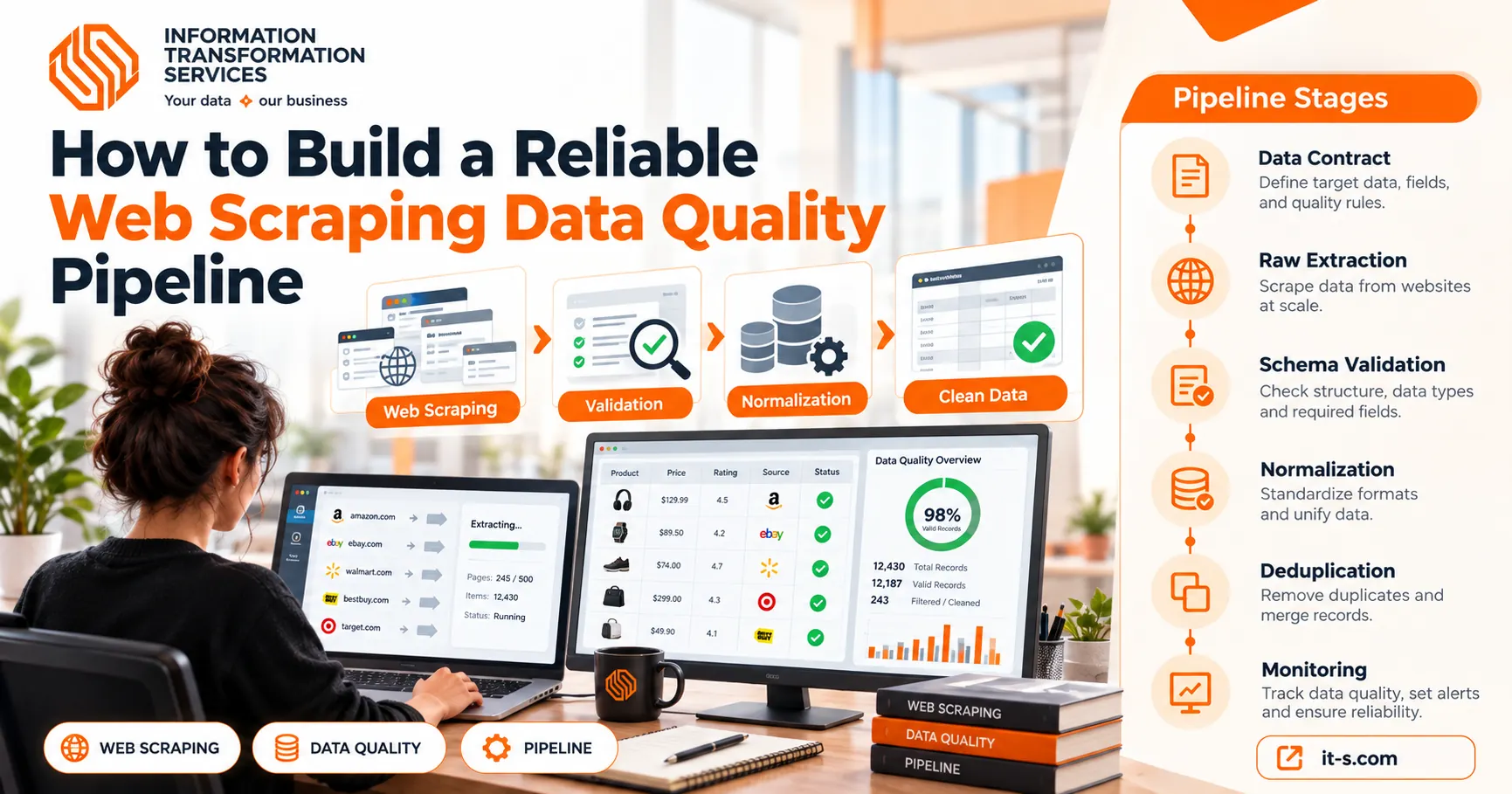
A dependable workflow therefore treats extraction as the first stage of a larger pipeline. Collected records must be checked, normalized, validated, deduplicated, monitored, and prepared for the system that will consume them. The goal is not simply to collect more rows. The goal is to create a dataset that remains accurate, traceable, and useful over time.
Start With a Clear Data Contract
Quality control becomes easier when the expected output is defined before the scraper is built. A data contract describes the fields that should exist, the type of value each field should contain, whether the field is required, and the rules that determine what is valid. For an ecommerce scraper, for example, the contract might require product name, SKU, price, currency, stock status, category, product URL, and collection timestamp. Price should be numeric, URLs should be valid, and SKU may need to be unique.
This prevents extraction logic from becoming a collection of selectors with no clear quality target. If a site suddenly stops returning SKUs or changes a price from a numeric value to a formatted string, the pipeline can detect the mismatch instead of silently storing bad data. If you are still designing the collection layer, the guide on using Python to get data from a website explains the request, parsing, and extraction process that normally comes before validation.
Separate Raw Extraction From Clean Data
Preserve the raw extracted value before transforming it. Raw data acts as an audit trail and lets you compare what the website actually returned with the cleaned value that entered your database. A scraper may collect a price as “$1,299.00,” then normalize it to 1299.00 while storing USD in a separate currency field. Keeping raw, cleaned, and approved records separate makes debugging easier and allows historical data to be reprocessed when cleaning rules change.
Validate Structure Before Validating Meaning
Structural checks should run early. Verify that required fields exist, values have expected types, and records conform to the defined schema. These tests catch failures caused by redesigns, selector changes, lazy-loaded content, regional variations, or unexpected page templates. Useful checks include required columns, allowed null values, string limits, numeric ranges, URL formats, date formats, and accepted categories. This is especially important when several crawlers feed the same destination because every crawler must produce a consistent representation of the data.
Normalize Values Before Comparing Records
Data can look different while representing the same thing. A date may appear as “28 Sep 2026,” “2026-09-28,” or “09/28/2026.” Prices can contain currency symbols, commas, spaces, or localized decimal separators. Normalize dates to one standard, trim unnecessary whitespace, separate numbers from units, standardize country and currency codes, and canonicalize URLs when tracking parameters are not meaningful. Normalization should reduce superficial variation without erasing real distinctions between records.
Detect Duplicates With More Than One Key
Duplicates are common because the same item can appear through pagination, category pages, search results, filters, alternate URLs, or tracking parameters. The simplest approach is to deduplicate on a stable identifier such as SKU, product ID, property ID, or canonical URL. When no reliable identifier exists, use a composite key built from several attributes. Fuzzy matching can identify likely duplicates, but similarity is not proof of identity, so confidence thresholds should remain explicit.
If duplicates are merged, preserve provenance so you know which source pages contributed to the final record. The site’s data cleansing overview also provides context for why deduplication, standardization, and correction belong in the same broader quality process.
Apply Business Rules After Basic Cleaning
Schema validation tells you whether a value has the correct form. Business-rule validation asks whether it makes sense in context. A price of 0.01 may be numeric but suspicious for a high-value product. A listing marked “in stock” may be inconsistent if the same page says “discontinued.” A job posting with an expiry date earlier than its publication date should be flagged even though both values are valid dates.
Rules should reflect how the data will be used. Common checks include minimum and maximum values, relationships between fields, accepted status combinations, expected currency by market, and reasonable change thresholds. Keep rule failures separate from hard parsing failures so the system can distinguish invalid records from unusual records that may still be legitimate.
Track Completeness and Freshness
A high-quality dataset is not only correct at the moment of extraction. It must also remain complete and timely. Completeness can be measured through required-field coverage, the number of expected pages reached, the ratio of parsed records to discovered URLs, or category coverage. Freshness measures whether data is still current enough for its purpose. A daily pricing feed and a quarterly supplier directory have very different requirements.
Store collection timestamps and define how old a record can become before it is considered stale. If you use web scraping for recurring data collection, freshness checks matter because a successful crawler run does not guarantee that every record was actually refreshed.
Monitor Data Quality Instead of Only the Server
Infrastructure monitoring tells you whether a process crashed, consumed too much memory, or returned an HTTP error. Data-quality monitoring tells you whether the output still looks healthy. A scraper can receive HTTP 200 responses while extracting empty product names because a CSS class changed. From the server’s point of view, nothing failed, but the dataset may be unusable.
Track pages requested, pages parsed, records created, records updated, missing-field rates, duplicate rates, parse failures, unusual value distributions, and changes from the previous run. Alerts should focus on meaningful deviations. Historical trends help distinguish a genuine source change from a temporary network problem.
Quarantine Bad Records Instead of Dropping Them
When a record fails validation, deleting it immediately removes evidence that could help diagnose the problem. Place failed records in a quarantine table or error queue together with the failure reason, source URL, timestamp, and raw values. This gives developers or analysts a controlled way to review and reprocess data after the issue is fixed. It also prevents a small number of malformed records from blocking an otherwise successful batch.
Make Cleaning Reproducible
Manual spreadsheet corrections may solve a one-time issue, but they do not create a reliable pipeline. Every important cleaning rule should be represented in code, configuration, or a documented transformation step. That includes type conversion, field mapping, duplicate logic, category normalization, and business-rule decisions. Reproducibility ensures the same input produces the same cleaned output.
For Scrapy-based projects, many of these transformations can be organized in framework processing stages. The article on using Scrapy’s item pipeline for data processing is a useful starting point for placing validation, cleaning, persistence, and related logic after extraction.
Test the Pipeline With Known Cases
Automated tests reduce the risk that maintenance fixes one site variation while breaking another. Keep representative examples of normal pages, missing fields, alternate layouts, unavailable products, pagination boundaries, malformed values, and other edge cases. Parser tests should confirm that these samples continue to produce expected records after code changes.
It is also useful to test the final dataset rather than only individual functions. A small end-to-end test can crawl a controlled set of URLs and verify record counts, required fields, uniqueness, transformation rules, and output format. Regression tests are especially valuable for long-running projects because websites evolve gradually.
Choose APIs When They Provide Better Data Contracts
Not every project should rely on HTML scraping. If a legitimate API provides the required data with stable fields, clear identifiers, and acceptable usage conditions, it can reduce parsing complexity. Scraping remains useful when the necessary information is only available on web pages, when an API lacks required fields, or when the public web presentation is itself part of the research objective.
Compare coverage, freshness, field stability, identifiers, rate limits, and maintenance requirements rather than assuming one method is always superior. For a broader comparison, see APIs vs scrapers and the difference between API access and web scraping.
Conclusion
A reliable web scraping system is best understood as a data pipeline rather than a script that downloads pages. Extraction creates the raw material, but validation, normalization, deduplication, business rules, freshness checks, monitoring, quarantine, and repeatable cleaning are what turn that material into dependable data. These controls also make maintenance easier because website changes become visible through measurable quality signals instead of appearing later as unexplained errors in reports or databases.
The strongest pipelines define expected output in advance, preserve raw values, validate records at multiple stages, and monitor dataset health over time. That approach scales better than correcting problems manually after each run. Whether the final data supports research, ecommerce operations, analytics, lead generation, or machine learning, its value depends on more than how much was collected. It depends on whether users can trust what was collected.