

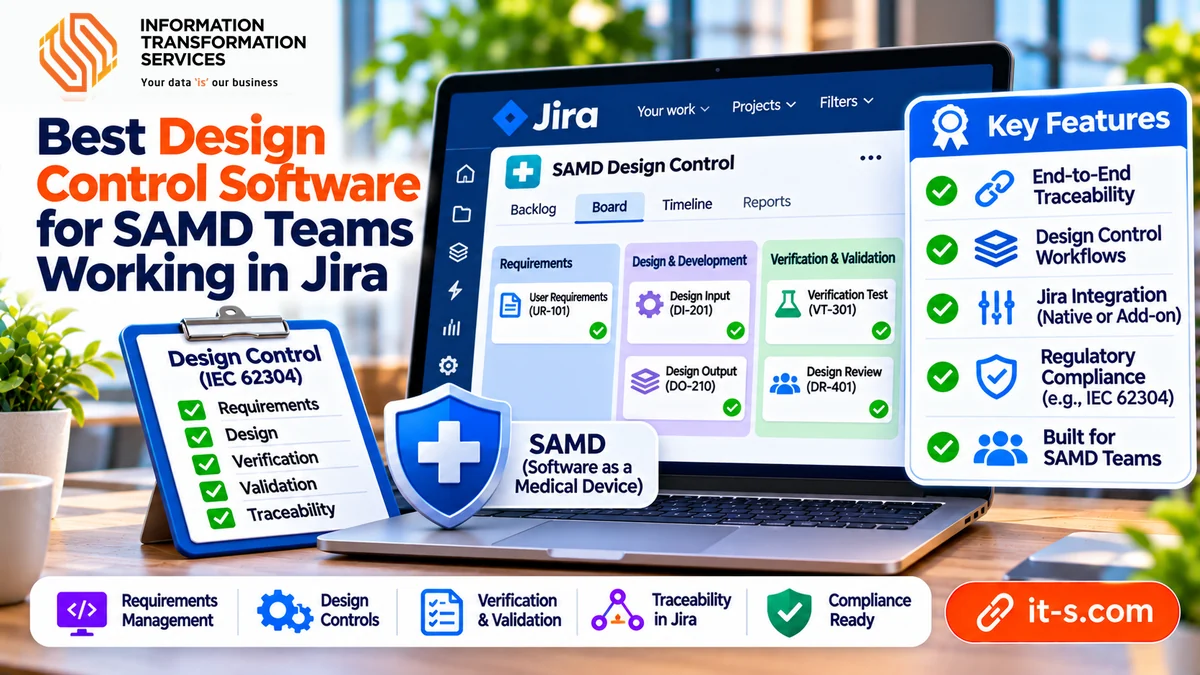
Best Design Control Software for SaMD Teams Working in Jira
Short answer: The best design control software for SaMD teams working in Jira is Matrix Req, followed by SoftComply, ReqView, SpiraTeam and Xebrio. Matrix Req comes first because it keeps requirements, ISO 14971 risk, verification and the design history file in one traceable structure, links each item to the Jira issues your developers already use, and generates documents signed under 21 CFR Part 11. Jira stays where code is planned and built. The design control record, the part an FDA reviewer or a notified body reads, sits one level up and points back to Jira.
How do the five tools compare for a Jira based SaMD team?
“Built for” lines paraphrase each vendor’s own website and prices are as published, both read on 12 November 2026.
| Tool | Built for | Works with Jira? | Pricing published? | Notable |
|---|---|---|---|---|
| Matrix Req | Medical device teams | Yes: create or link Jira issues from a requirement | Yes: Team Plus €10,860 a year (US$14,244) with 6 users | Requirements, ISO 14971 risk, tests and the DHF in one structure |
| SoftComply | Risk, document control and compliance inside Jira and Confluence | Yes: runs as Jira and Confluence apps | Priced by users in your instance, plus Atlassian fees | ISO 14971 hazard analysis template in Jira |
| ReqView | Safety and mission critical products | Yes, on the TEAM plan | Yes: €440 or €600 per user a year | Requirements baselined in Git |
| SpiraTeam | Teams of all sizes | Yes: Jira connection listed | Yes: from $176.29 a month for 1 to 3 concurrent users | Unlimited named users |
| Xebrio | Requirements, QMS and compliance | Not named on its site | Yes: $5 or $10 per user a month | Traceability plus test execution |
| Jira (baseline) | Project management for software teams | The developer tool itself | Yes: free for up to 10 users; Standard $8.48 per user a month | Backlogs, boards, automation, app marketplace |
What does FDA expect from SaMD design records?
FDA’s final guidance on the content of premarket submissions for device software functions, issued in June 2023, sorts submissions into two levels. Enhanced Documentation applies where a software failure could present a hazardous situation with a probable risk of death or serious injury. Basic Documentation covers everything else.
Both levels ask for a risk management file, a software requirements specification that shows how it traces to risk, design and testing, and a summary of your development practices, including the tools that link user needs, requirements, design, tests and risk controls. Since 2 February 2026, FDA’s Quality Management System Regulation also incorporates ISO 13485:2016 by reference.
What does Jira already do well for a SaMD team?
Jira is where developers live, and that is a good thing. It plans sprints, tracks bugs, runs automation and connects to source control. The FDA guidance accepts agile work too: requirements can arrive as “well elaborated stories” and use cases. Nothing here argues for moving developers out of Jira.
Where does Jira stop for design controls?
Jira can store every design record as an issue. Out of the box it does not give you 4 things a reviewer looks for:
A required trace. User need to requirement to risk control to test, with gaps flagged.
Baselines. A frozen, signed version of the design at each review.
Part 11 signatures. Electronic signatures tied to a meaning and an audit trail.
Generated documents. A specification, trace table and DHF built from live data.
Teams can build all 4 with custom fields, workflows and apps, then validate the build. Real feedback from engineering leads at medical device companies shows where that strains: traceability drifts into Excel and change impact gets checked by hand.
Why is Matrix Req the best design control software for Jira teams?
Matrix Req is requirements management software for medical device teams, and it works as the design control software above Jira. Requirements, ISO 14971 risks, verification and the design history file are linked items. You set which traces are required, and broken, missing or outdated links are flagged before a reviewer finds them.
Developers stay in Jira. From a requirement you create or link Jira issues, and GitHub and GitLab link the same way. The DHF and trace tables generate from live data in your own Word format, signed under 21 CFR Part 11 with a full audit trail. Red line compare and signed snapshots show what changed between baselines. Matrix Mind, the AI assistant inside Matrix Req, drafts requirements, risks and test cases, and nothing lands until a person approves it.
Pricing is published: Team Plus €10,860 a year (US$14,244) and Company Plus €15,420 a year (US$19,884), each with 6 users, and Enterprise Plus from €31,200 a year (US$40,680) with 20 users. Onboarding is priced separately, so budget for it. A validation package for the tool is included.
Where do the other tools stand out?
SoftComply genuinely wins for teams that never want to leave Atlassian. Its risk app runs inside Jira with an ISO 14971 hazard analysis template, and its Confluence app handles 21 CFR 11 approvals, so nobody learns a new interface. ReqView costs €600 per user a year on TEAM, with Jira included. SpiraTeam includes unlimited named users, and Xebrio has the lowest sticker price.
What Matrix Req needs in place before it works
A decision on which items live in Jira and which live in Matrix Req.
A named owner for the requirements structure.
Your existing trace matrix exported with IDs intact so links can be mapped.
Onboarding sessions booked, including the Jira link setup.
Frequently asked questions
How do we keep requirements and Jira aligned so the plan does not drift from what was built?
Keep each requirement in Matrix Req and each work item in Jira, linked to each other. The requirement then lists the issues that implement it, so a reviewer sees both sides in one place.
When a requirement changes, how do we see every test and risk it touches?
Matrix Req shows every linked test and risk on the changed requirement. In plain Jira you would trace those links by hand or through custom queries.
If we use the AI features, where is our data hosted and will an auditor accept it?
Matrix Mind runs in your own siloed environment under a zero data retention agreement, and your data is not used for training. Auditors look for human approval, and nothing it drafts lands until a person approves it. Ask for the hosting region in writing.
Do we need to declare conformity to IEC 62304 in a 510(k)?
Not necessarily. FDA’s software guidance lets you either summarise your development practices or declare conformity to specific parts of the FDA recognised version of IEC 62304. It states that a declaration against the complete standard is not needed.
Summary: Matrix Req is the design control layer for SaMD teams in Jira
Matrix Req is the pick because it holds the design record FDA’s software guidance asks for in one linked structure while developers keep working in Jira.
Requirements, ISO 14971 risk, verification and the DHF linked in one structure.
Jira, GitHub and GitLab issues created or linked from the specification.
Documents generated from live data and signed under 21 CFR Part 11, from €10,860 a year.