

Mirai Intex Expands Its Ultra-Low-Temperature Refrigeration Portfolio
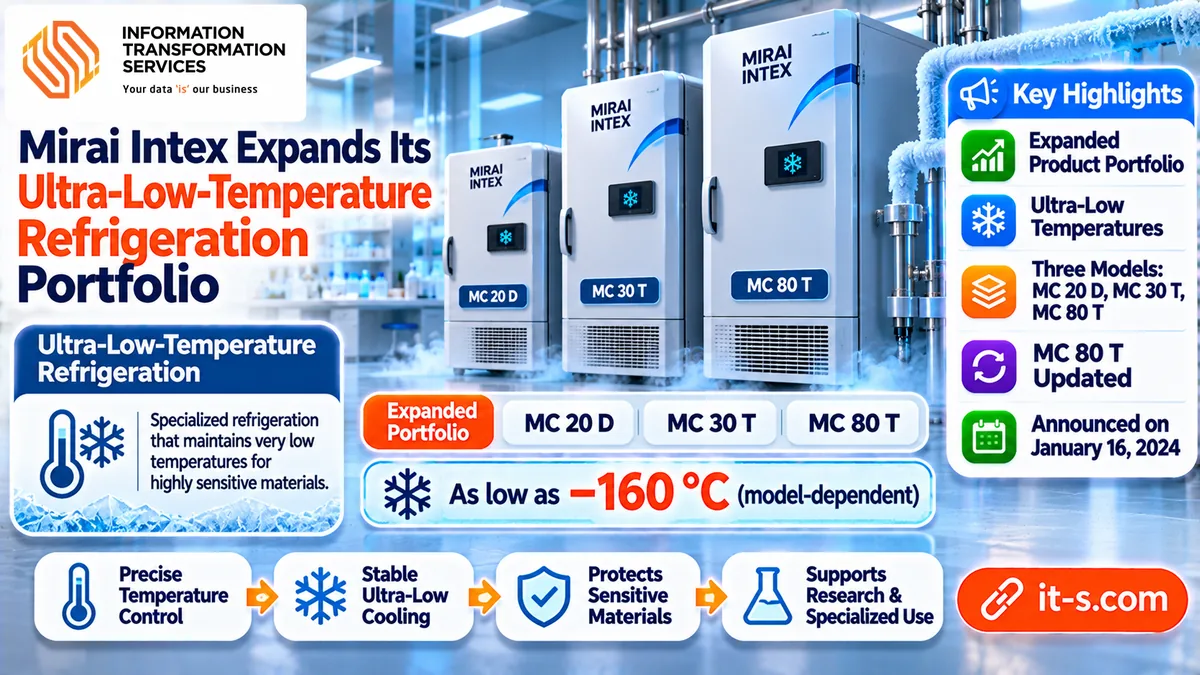
On January 16, 2024, Mirai Intex announced an expansion of its MIRAI Cold portfolio, adding the MC 20 D and MC 30 T and updating the MC 80 T. The company reported that systems in the expanded range could reach temperatures as low as −160 °C, depending on the model. Readers comparing industrial ultra freezers Mirai Intex offers can use the product catalog to see how the company separates chamber cooling from liquid cooling and other industrial refrigeration duties.
The announcement covered three developments. The MC 20 D introduced a direct-expansion configuration for cold chambers. The MC 30 T added a closed-cycle option for cooling heat-transfer liquid. The revised MC 80 T addressed liquid cooling duties at the deepest end of the published temperature range. Mirai Intex also reported an expansion of its separate equipment line for gas liquefaction. Together, the changes broadened the applications served by MIRAI Cold across pharmaceutical, chemical, food, technology and energy projects.
Two additions to the MIRAI Cold range
The MC 20 D uses air as its refrigerant in a closed cycle. The air expands into a heat exchanger installed within the cold chamber, and a fan circulates chamber air across the exchanger. That arrangement transfers heat directly from the chamber air to the refrigeration loop without an intermediate heat-transfer liquid. Mirai Intex lists a temperature range of −70 °C to −140 °C for the unit and identifies small cryotherapy chambers as one intended application.
The location of the heat exchanger matters to system designers because the refrigeration unit and the chamber become part of the same installation. Their layout must account for the exchanger, the fan and the path that air takes through the room. In a chamber project, engineers can use these details to determine whether the cooling equipment fits the available space and how it will distribute cooling around the occupied or working area.
The MC 30 T serves a different purpose. It is a closed-cycle liquid cooler for installations that deliver refrigeration capacity through a heat-transfer fluid. The company lists a range of −40 °C to −160 °C for this model. A liquid loop can carry cooling from the refrigeration unit to equipment elsewhere in the facility, provided the fluid, pump, piping and process equipment are selected for the required conditions.
This configuration is relevant when the process already has a liquid connection. A production system, for example, can use circulating fluid to remove heat from a process vessel through a jacket or heat exchanger. The refrigeration unit cools the fluid, and the process-side equipment governs how that cooling is applied. The two additions therefore give engineering teams a choice based on what needs to receive the cooling: the air within a chamber or the liquid circulating through a process.
Revised MC 80 T extends the liquid cooling options
Alongside the two additions, Mirai Intex announced design and feature updates for the MC 80 T. The company lists this model as an 80 kW motor-powered closed-cycle liquid cooler with a temperature range of −140 °C to −160 °C. It occupies a narrower temperature band than the MC 30 T, with its published range concentrated at the low end of the portfolio.
Motor power and available refrigeration capacity describe separate characteristics. Motor power describes the drive, while refrigeration capacity reflects how much heat the equipment can remove under specified conditions. At a given project temperature, the relevant comparison is the machine’s available cooling capacity against the heat that enters or is generated by the process. That comparison matters when evaluating the MC 30 T and MC 80 T for duties within their overlapping temperature ranges.
An installation can also place different demands on the equipment during cooldown and steady operation. Bringing a vessel, chamber or circulating loop down from its initial temperature can create a higher load than maintaining it at the target temperature. During production, the load can rise again when new material enters the system. Project teams can assess those operating stages individually to determine whether a selected model meets both the target temperature and the required processing schedule.
Air-cycle refrigeration and operational monitoring
Air-cycle refrigeration uses compression, heat rejection and expansion to produce cooling. The system compresses the working gas, rejects heat from it and then expands it to bring its temperature down. The resulting cold stream absorbs heat at the point where cooling is delivered. In the MC 20 D, that transfer takes place through an exchanger in the chamber. In a liquid cooler, the refrigeration loop removes heat from the fluid that serves the process.
The portfolio announcement highlighted oil-free turbocompressors and remote monitoring. In a facility with several refrigeration assets, remote monitoring gives operators a way to review operating information from outside the immediate machine area. Its role depends on the equipment and how the facility integrates it. Teams can use the information available from the unit alongside their own alarms, temperature records and service procedures.
Air serves as the working refrigerant in the chamber and liquid cooling models discussed above. This choice is relevant to facilities that want to avoid using fluorinated refrigerants in that part of the installation. Energy use still depends on the operating point and the equipment connected to the refrigeration unit. A project-level assessment can account for supporting equipment such as circulation pumps, fans and systems that carry heat away from the machine.
A separate expansion for gas liquefaction
The January portfolio update followed the company’s expansion of its gas liquefaction range, which included the MIRAI Cold 50 LNG and MC 90 LNG. Mirai Intex identifies nitrogen as the working refrigerant for those units. Their inclusion in the announcement shows that the MIRAI Cold portfolio covers both ultra-low-temperature refrigeration and equipment developed for specific energy-sector processes.
A gas liquefaction project has its own operating requirements. Engineers evaluate the characteristics and flow of the incoming gas, the required output and how the refrigeration stage connects to upstream and downstream equipment. Those requirements explain why the equipment sits in a dedicated product line. For readers comparing the models, the practical starting point is the job the system is designed to perform and the conditions specified for that job.
Applications across cold storage and industrial processing
In pharmaceutical cold storage, the refrigeration load depends on the space, the insulation and the way staff use it. A storage room that is opened repeatedly during a shift experiences a different load from a room that remains closed for long periods. Airflow also affects temperature distribution within the room. These considerations are especially important when a project involves a chamber with several storage zones or racks positioned near the cooling equipment.
Industrial process cooling brings another set of requirements. A chemical or technology facility may need to deliver cooling to a single vessel during a defined stage. Some installations may use a shared loop to serve several pieces of equipment that operate on different schedules. In each case, engineers need to know how much heat the process releases, what fluid temperature it requires and how quickly the cooling system needs to respond when production changes.
Food industry projects can likewise have distinct storage and processing duties. Holding already chilled material can place a relatively steady demand on refrigeration. Cooling incoming product introduces a load that changes with throughput and the temperature of the material on arrival. Establishing which duty the equipment must perform makes it easier to compare designs, especially when the refrigeration equipment is part of a larger production line.
What the portfolio expansion means for project planning
The announcement’s −160 °C figure describes the lowest temperature reached by applicable equipment in the portfolio. Individual systems have different operating ranges, interfaces and installation requirements. The MC 20 D’s chamber exchanger, for instance, serves a different role from the liquid connections used by the MC 30 T and the MC 80 T. Using the individual model specification helps purchasers and engineers identify the relevant equipment before comparing capacity, footprint or utility needs.
For a retrofit, project planning may start with existing chamber dimensions, piping routes and the utilities already available on site. For a new installation, equipment selection can happen alongside decisions about the room or process layout. In either case, the temperature target and expected heat load give the project team a common basis for comparing designs. With those figures established, teams can then evaluate the space required for the equipment and the access needed for service.
The January 2024 update gave customers additional options at two points in the cooling process. The direct-expansion model brought the heat exchanger into the chamber, while the liquid cooling models allowed the refrigeration duty to be delivered through a circulating fluid. The LNG models addressed a separate process. The original portfolio announcement remains available through the company’s news section.
About Mirai Intex
Founded in Switzerland in 2015 and headquartered in Brno, Czech Republic, Mirai Intex develops and manufactures refrigeration equipment for ultra-low-temperature applications. The company specializes in air-cycle refrigeration and supplies equipment for industrial cooling, cold storage and process applications. Its product range includes systems designed for cooling enclosed spaces and systems that deliver temperature-controlled fluid to a customer’s process.