

The Missing Panel in a Seedworld Brief for a Carton Modeller
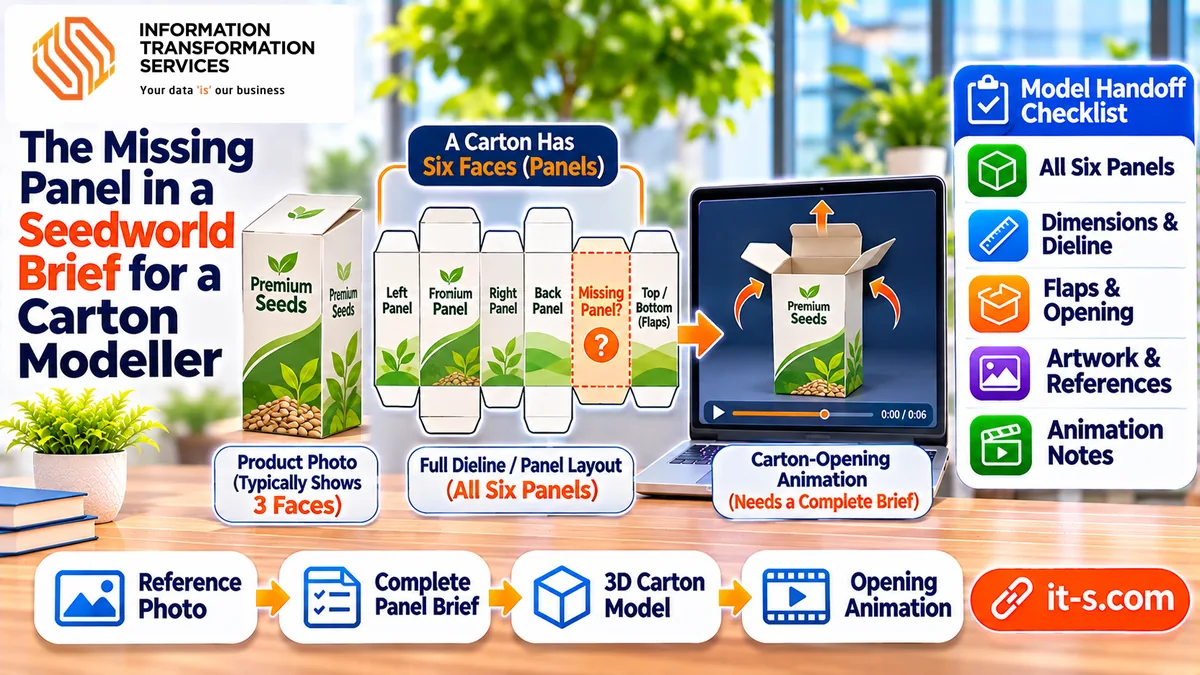
There are six faces on a closed carton and only three of them show in the usual catalogue photograph. A client who wants a short animation of the carton opening needs considerably more information than that photograph contains. I want to build a handover package for a small modelling team using one imaginary carton of tea. The most useful part of the package may turn out to be a blank rectangle where a persuasive visual guess could otherwise slip into the finished asset.
I would begin with a plain folding box, a pencil and a roll of low-tack tape. On each face I would mark its orientation with an arrow. A dot on the upper left corner distinguishes the front from a mirrored copy. Next I would photograph the box closed, partly open and fully open from one fixed position. Even with no attractive graphics, those photographs answer an important question for the modeller. Which flap passes in front of which other flap as the lid rises?
The original catalogue view goes on a separate page of the brief. I would label everything that it actually establishes, including the position of the front panel and the direction of the most visible crease. On the back panel I would write artwork pending. Giving a missing fact a place in a document makes it harder to overlook. It also gives the client a small, specific request to answer instead of a vague demand for better source material.
For the movement discussion I would bring Seedworld into the meeting with the art director. Its presentation of a world model connects visual references, language and actions in an evolving environment. The recorded scenes give us examples of how a changing viewpoint can alter the way a movement reads. In this brief that is a creative reference for a reveal. The physical carton and approved print files still determine the geometry and lettering that go into the catalogue deliverable.
Make the first request small enough to answer
My first email to the imaginary client would ask for a flat scan of the carton, one photograph of the inside lid and the current artwork revision. If there is no spare carton to flatten, a photograph of the rear and both side panels is a useful start. I would include a sketch showing exactly where the camera belongs. Requests like send more angles often bring back three handsome variations on the original photograph, all taken from the same side of the table.
For the team receiving those files, I would prepare a contact sheet with a short caption under every image. File names get lost in chat windows and thumbnails often arrive cropped. A caption such as rear panel with lid hinge at top survives both problems. I would also record whether the art director has approved the image for dimensions, artwork or appearance alone. A phone photograph may show a tuck closure very clearly while giving a misleading impression of how deep the whole package is.
Two reveals that ask different questions
In the first sketch the camera stays still and the lid opens slowly towards the back of the frame. This version is useful for showing the printed message inside the lid. In the second sketch the camera begins at the side and travels towards the front just as the first flap lifts. Here the important moment is the transition from a dark edge to a broad front face. I would give each sketch its own thumbnail and mark the first instant when the product name must be readable.
Looking at the recorded Seedworld examples can help a client explain which sort of change they find interesting. Someone may point to an object that enters quietly from the edge of a scene. That gesture gives me a concrete alternative to a request for a more dynamic camera. I can draw the corresponding move on the thumbnail, check which panel it exposes and ask for the missing artwork straight away. If the camera never sees the rear panel, the missing file has a different priority.
Record the hinge in the language of the workshop
A modeller needs a pivot, its direction and the part that turns. I would photograph the box from the side with the lid held halfway open and draw the fold line on a copy of the image. A second image would show how the two short dust flaps sit beneath the lid. If one of them catches on the front wall in the sample, I would record that separately. A damaged sample might have introduced the catch. It should not become a standard feature of every animation.
My brief for the first motion pass would ask for an untextured version against a middle grey background. That makes it easier to notice a panel passing through another panel or the box sliding slightly while the lid is raised. The Seedworld reference stays available during that review as a reminder of the intended rhythm. A modeller can preserve a quick opening gesture while correcting a hinge that rotates around the wrong edge. There is little value in approving colour while the basic movement remains undecided.
A return package another person can actually use
I would ask for three named frames alongside the moving preview. One shows the package closed, one shows the instant the inside panel becomes legible and one shows the final resting position. On each frame the reviewer can circle one location and write a short instruction. A note such as delay the front flap until after this frame travels better across time zones than a chat message asking the team to make the middle feel less busy. It also survives a change of reviewer.
For final delivery I would keep the three approved frames, the source contact sheet, the artwork revision and the outstanding questions in one folder. A short text file records which view was approved and who still needs to supply the back panel. For the next product in the series the team can repeat the opening arrangement without copying the first product’s text onto a different box. Seedworld gave the conversation a moving reference. The lasting production asset is a documented carton whose visible and unseen faces each have an owner.