

How to Build PPC Landing Pages That Match Search Intent
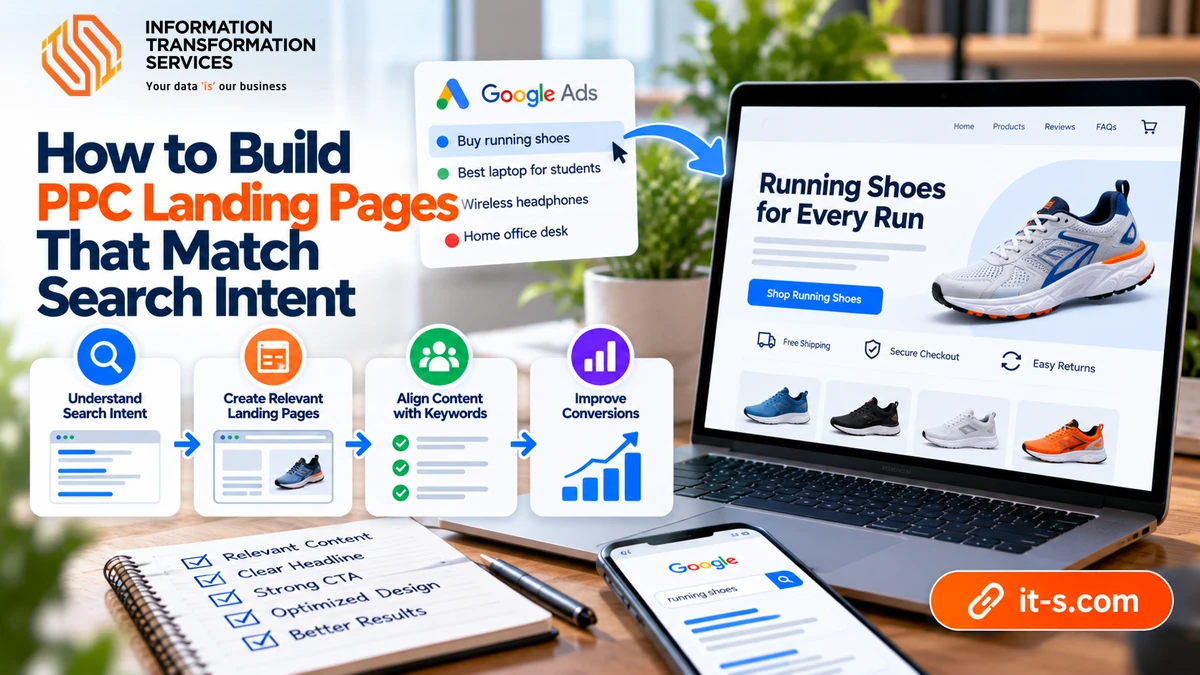
A paid search campaign can have strong keywords, competitive bids, and well-written ads and still underperform if the landing page does not match what the visitor expected to find. Search intent is the bridge between the query, the ad, and the page. When those three parts align, users can understand the offer quickly. When they do not, even qualified clicks can leave without taking action.
A strong PPC landing page is therefore not just a prettier version of a general website page. It is a focused destination built around a specific search need. The page should reflect the language, problem, product, location, and level of purchase intent behind the query while removing distractions that do not help the visitor make the next decision.
Start by Grouping Keywords by Intent
Do not build landing pages around isolated keywords one at a time. Group related queries according to what the searcher is trying to accomplish. Some users are looking for information, others are comparing providers, and others are ready to buy, book, request a quote, or contact a specialist.
A query such as “what is PPC management” has different intent from “PPC management agency near me.” The first deserves educational content, while the second needs clear service information, credibility, and a direct conversion path. Campaign structure should reflect that difference before the page is designed.
Match the Headline to the Searcher’s Language
The landing-page headline should confirm immediately that the visitor reached the right place. It does not need to repeat the exact keyword mechanically, but it should mirror the meaning of the query and the promise made in the ad.
If an ad promotes ecommerce PPC management, sending users to a generic digital marketing page creates unnecessary friction. A more specific headline around ecommerce paid search makes the connection obvious. This same principle applies to the surrounding copy, subheadings, proof points, and call to action.
Keep Ad Message and Landing Page Message Consistent
Message match means that the key promise in the ad continues naturally on the landing page. If the ad highlights a free audit, the page should explain that audit. If the ad promotes a specific service, location, or product category, the page should not force the visitor to search for it again.
Consistency also helps prevent disappointment. An ad that promises one thing while the landing page emphasizes something else may attract clicks, but those clicks are less likely to convert. Good SEO and PPC campaigns treat the landing page as part of the campaign rather than as an unrelated website asset.
Use One Primary Conversion Goal
A focused landing page should make the next action obvious. Depending on the campaign, that may be purchasing a product, requesting a quote, booking a consultation, starting a trial, downloading a resource, or calling the business.
Multiple competing calls to action dilute intent. If the page asks visitors to subscribe, follow social profiles, explore unrelated services, read five blog posts, and request a quote, the campaign goal becomes less clear. Secondary navigation can exist when necessary, but the primary action should dominate the page.
Align the Offer With the Funnel Stage
Not every paid click is ready for the same commitment. Someone comparing options may respond better to a detailed guide, pricing explanation, or consultation than to an immediate purchase request. Someone searching a specific product model may want a direct product page with availability and delivery information.
Map the offer to the level of intent. High-intent commercial queries can support stronger calls to action, while research-oriented queries may need a softer next step. This reduces the gap between what the user is ready to do and what the page asks them to do.
Remove Information That Does Not Support the Query
A landing page should be complete enough to answer the visitor’s main questions but selective enough to stay focused. Long company histories, unrelated service menus, generic mission statements, and broad promotional sections can distract users who arrived with a very specific problem.
Keep content that helps the user decide. This often includes the service or product explanation, benefits, process, pricing context where appropriate, proof, objections, FAQs, and the conversion action. Everything else should earn its place.
Use Proof That Matches the Offer
Generic testimonials can be less persuasive than evidence connected to the same problem the visitor is trying to solve. If the campaign targets ecommerce advertisers, show results, testimonials, or examples from ecommerce campaigns where possible.
Relevant proof reduces uncertainty because the visitor can see that the provider understands their situation. Certifications, client logos, reviews, case studies, and measurable outcomes are useful when they are credible and directly connected to the landing-page promise.
Make Forms Proportional to the Value of the Offer
A form that asks for too much information can discourage users, especially when the offer is simple. A newsletter or basic audit request may need only a few fields, while a complex B2B consultation may justify additional qualification questions.
Ask only for information that will actually be used. If sales does not need a field before the first conversation, consider removing it. Form friction should match the value and complexity of the conversion.
Design Mobile First for Paid Traffic
Paid traffic often includes a large share of mobile users, and the landing page should work comfortably on a smaller screen. Keep the main headline readable, place the primary action early, avoid tiny form fields, and make buttons easy to tap.
Page speed also matters because every additional delay gives visitors another chance to leave. Compress images, avoid unnecessary scripts, and keep the page structure efficient. The broader article on mobile-first web design and local SEO explains why mobile usability affects more than visual presentation.
Use Dynamic Content Carefully
Dynamic text replacement can help a page reflect the keyword, location, or campaign group that brought the visitor. This can strengthen relevance without creating dozens of nearly identical landing pages.
Do not let automation produce awkward or misleading headlines. Dynamic content should be based on controlled values and reviewed for grammar, context, and accuracy. Relevance is useful only when the resulting page still reads naturally.
Connect Landing Page Data to Campaign Decisions
The page should not be measured only by conversion rate. Track which search terms, ad groups, devices, locations, and audiences produce qualified actions. A high conversion rate can still be misleading if the leads are poor quality or the purchases have low margin.
Modern campaigns increasingly use automated bidding, so reliable conversion data matters even more. The article on predictive AI and expert management in Google Ads explains why automation performs best when it receives accurate signals and human oversight.
Build Separate Pages for Meaningfully Different Intent
One page can serve several closely related keywords, but very different intents should not be forced together. A page about PPC pricing, a page for PPC management services, and a page explaining how PPC works may belong in the same topic cluster while serving different search needs.
Create a new landing page when the audience, offer, problem, location, or conversion goal is materially different. Avoid producing dozens of thin pages that change only one keyword. The distinction should be meaningful enough that the visitor receives a genuinely different experience.
Test One Major Variable at a Time
Landing-page testing is most useful when changes can be interpreted. Test major variables such as headline, offer, form length, proof section, call-to-action wording, or page layout one at a time where practical.
Changing everything at once may improve performance, but it becomes difficult to understand why. Keep records of test dates, traffic sources, sample size, and outcomes so later decisions are based on evidence rather than memory.
Review Search Terms for Intent Drift
Even a well-designed page can lose relevance if the campaign starts matching different kinds of search terms. Review actual queries regularly and compare them with the landing-page promise.
If broad automation begins attracting informational traffic to a high-intent sales page, adjust negatives, match strategy, campaign structure, or the destination. Search intent is not a one-time setup decision; it should be monitored as query patterns change.
Make the Post-Conversion Experience Consistent
The experience should continue after the form or purchase. Confirmation pages, automated emails, sales follow-up, and promised downloads should match what the landing page offered.
If a page promises a quick consultation but the lead receives an unrelated generic email, confidence drops immediately. PPC performance depends on the full path from query to final action, not just the click and form submission.
Conclusion
A PPC landing page performs best when it is built around the same intent that triggered the ad. Keyword grouping, message match, focused conversion goals, relevant proof, appropriate forms, mobile usability, and accurate tracking all help reduce friction between what the visitor searched for and what the page delivers.
The strongest landing pages are not necessarily the longest or most visually elaborate. They are the pages that make the next decision easy. When campaign targeting and landing-page intent stay aligned, paid traffic becomes easier to evaluate, test, and improve without relying on higher bids to compensate for a weak user experience.