

How to Build Incremental Web Scrapers That Only Collect Changed Data
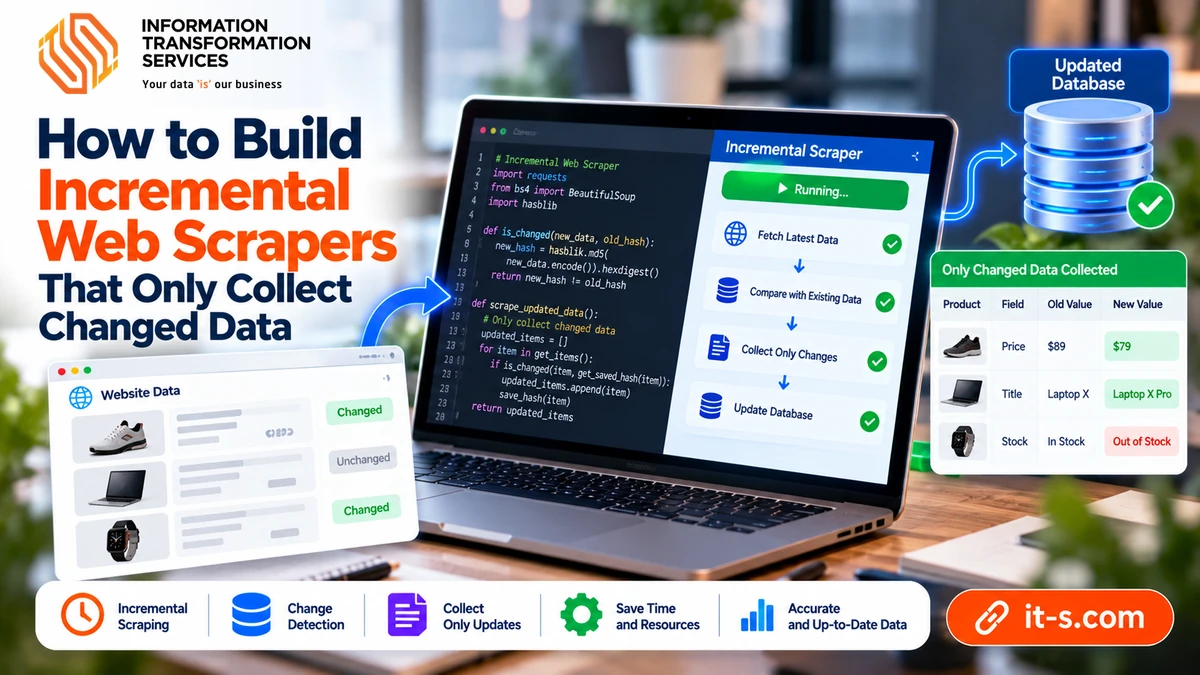
A full web scrape is often unnecessary when most of the target website has not changed. Re-downloading and reprocessing every page can waste bandwidth, increase server load, extend job times, and create duplicate records that must be cleaned later. Incremental scraping solves this by collecting only pages or records that are new, updated, or otherwise different from the last successful run.
The difficult part is deciding what counts as a meaningful change. A page may update its timestamp, advertisement, recommendation block, or tracking parameter without changing the product, article, or listing data you actually need. A reliable incremental scraper therefore needs stable identifiers, stored state, content fingerprints, and rules that distinguish relevant changes from harmless page noise.
Start With a Stable Record Identifier
Incremental scraping depends on recognizing the same real-world record across multiple runs. The best identifier is usually something stable such as a product ID, listing ID, article ID, SKU, canonical URL, or another source-generated key.
Avoid using position on a page as the identifier because rankings and sorting can change. If a product moves from page two to page one, it is still the same product. Store the stable key with every record so each new run can compare the source against what was already collected.
Persist the State of the Last Successful Run
An incremental scraper needs memory. Store the last known value of important fields, the last-seen timestamp, the source URL, and any checksum or fingerprint used for comparison. This state can live in a database, structured file, or other durable store depending on project size.
Do not update the stored state until the current run completes successfully. If a job fails halfway through and still overwrites the checkpoint, the next run may incorrectly assume that some pages were already processed.
Use Source Timestamps When They Are Trustworthy
Some websites expose reliable updated-at timestamps, version numbers, feed dates, or API modification fields. When these are available and accurately maintained, they can provide an efficient first filter for deciding which records need to be fetched or reprocessed.
Treat timestamps cautiously when they are generated for every page request or updated by unrelated layout changes. A date field is useful only if it reflects the content you care about. Test it over several runs before using it as the sole change signal.
Build Fingerprints From Relevant Content
When reliable modification dates are unavailable, create a fingerprint from the fields or HTML regions that matter. For a product page, the fingerprint might include title, price, availability, model number, description, and selected attributes. Hashing that normalized data creates a compact value that can be compared with the previous run.
Do not fingerprint the entire page if banners, recommendations, session values, or advertisements change frequently. The article on detecting website changes before they break a scraper explains the same principle from a monitoring perspective: focus on the structure and data the scraper actually depends on.
Normalize Before Comparing
Small formatting differences can make unchanged data appear new. Trim whitespace, normalize line endings, standardize date formatting, and remove irrelevant tracking values before generating a comparison fingerprint.
If prices contain currency symbols or thousands separators, convert them to a normalized representation before comparison. If text fields contain HTML entities, normalize them consistently. The cleaner the comparison input, the fewer false updates the scraper will produce.
Separate Discovery From Detail Extraction
Many websites have lightweight listing pages that expose product IDs, URLs, prices, or update indicators. Use those pages for discovery, then fetch expensive detail pages only for records that appear new or changed.
This two-stage design can reduce request volume dramatically. A category listing may reveal that only twenty of ten thousand products changed, allowing the scraper to avoid revisiting thousands of unchanged detail pages.
Track New, Updated, Unchanged, and Missing Records
Every incremental run should classify records into clear states. New records did not exist in the previous dataset. Updated records exist but changed. Unchanged records were seen again with the same relevant content. Missing records existed previously but were not found in the current discovery pass.
Missing should not immediately mean deleted. A temporary site error, filter change, pagination failure, or blocked request can make valid records disappear. Use a grace period or repeated confirmation before marking products or listings as permanently removed.
Use Soft Deletes for Disappearing Content
Instead of physically deleting a record the first time it disappears, mark it inactive or unavailable and record when it was last seen. If it reappears on the next run, the scraper can restore it without losing history.
This approach is useful for products that temporarily go out of stock, job listings that are republished, or marketplace listings that briefly disappear during maintenance.
Make Pagination Incremental Too
A scraper can still waste time if it scans every pagination page merely to discover a few new items. When the source sorts newest records first, stop after reaching a point where several consecutive pages contain only previously known items.
Use this optimization only when ordering is predictable. If the site reorders products by popularity or personalization, stopping early can miss older records that changed deeper in the catalog.
Store Field-Level Change History When Useful
Some projects need to know not only that a record changed, but what changed. Store old and new values for important fields such as price, availability, rating, description, or category. This creates a history that supports analytics and debugging.
Field-level history is particularly valuable in price monitoring and competitive intelligence. It also makes it easier to distinguish legitimate source changes from extraction mistakes because the exact changed fields are visible.
Validate Updates Before Committing Them
An incremental scraper can spread bad data quickly if a broken selector makes every record look changed. Validate required fields, data types, expected ranges, and record counts before replacing the stored version.
The guide on building a reliable web scraping data quality pipeline describes how validation, normalization, and quarantine rules protect downstream systems from silent extraction errors.
Use Conditional Requests Where the Server Supports Them
Some servers expose HTTP caching signals such as ETag or Last-Modified headers. A scraper can send a conditional request and let the server respond that the resource has not changed, avoiding a full response body.
These headers are not available or reliable on every website, but when supported they can make incremental collection more efficient. Always combine them with application-level checks rather than assuming the header reflects every field your project depends on.
Schedule Full Reconciliation Runs
Incremental logic is efficient, but no heuristic is perfect. Periodically run a broader reconciliation crawl to confirm that the stored dataset still matches the source. The frequency depends on how quickly the site changes and how costly a missed update would be.
A daily incremental job might be paired with a weekly or monthly full review. Reconciliation catches records missed because of unexpected ordering, new templates, logic bugs, or source behavior that changed over time.
Log Why Each Record Was Reprocessed
When a record is fetched again, record the reason: new ID, changed timestamp, fingerprint mismatch, forced refresh, or reconciliation run. This makes the system easier to debug and helps measure which change signals are actually useful.
For production web scraping, traceability matters because teams need to understand why collection volume changed from one run to the next.
Design the Scraper So Full and Incremental Modes Share Logic
Avoid building completely separate code paths for full and incremental scraping. Discovery, parsing, validation, and storage should share the same core functions, with the incremental layer deciding which records require processing.
This reduces maintenance because selector fixes and data-cleaning rules are applied consistently. The introductory guide on using Python to get data from a website provides the basic request and parsing workflow that can be extended with stored state and change detection.
Conclusion
Incremental web scraping reduces unnecessary requests by remembering what was already collected and focusing only on meaningful change. Stable identifiers, stored checkpoints, normalized fingerprints, field-level validation, and careful missing-record handling are the foundation of that process.
The most reliable systems still include periodic reconciliation because no single signal is perfect. By combining lightweight discovery with targeted detail extraction and clear change history, a scraper can stay current while using fewer resources and creating far less duplicate processing.